
177. A Season of Pure White and Hearts That Are Not (3).
Basilikinos. Or Basilikinos.
It had been half a year since the man who was once commander of The Emperor's personal guard became the lord of Cherson.
From the moment he first set foot in Cherson, this outstanding cavalry commander had understood the city's importance.
Economically, of course, Petronas, the former lord who became The Emperor's finance officer, likely knew much more than Basilikinos himself, but from a military standpoint of the Eastern Roman Empire, Cherson was also an extremely significant place.
'No, the word "extremely significant" cannot fully explain it.'
He had thought it was merely a city that checked the northern nomads and controlled the Black Sea, but now Cherson had transformed into a place that bore The Emperor's might.
The reason was, of course, the fierce warriors who poured in from the vast lands of the North Sea.
Under Fylkir's favor, the Roman scholars, most of whom were affiliated with the North Sea research institute, sent word that the population of the North Sea was continually rising.
Incomprehensible. Unbelievable. Impossible.
These three phrases that commonly appeared in the scholars' documents no longer surprised the officials of the Eastern Roman Empire.
Well, considering the ruler of the North Sea who had romped across battlefields as if they were his playground, trying to judge that cold land by Roman common sense might itself be the problem.
What mattered to Rome and The Emperor was not the scholars' confusion or the bishops' concerns, but that the North Sea was an exceedingly ideal market and ally, a place where warriors who were loyal only to The Emperor in proportion to the value of silver coins could be obtained.
In Basilikinos' view, the project to expand the Varangian Guard, which had begun merely out of fondness and admiration for Fylkir Helgi Ragnarsson, had now become an indispensable policy for securing a standing army for The Emperor.
Their number had already reached a thousand. There were Svear, there were Danes, and even warriors among the Angles and Saxons conquered by Fylkir who could not bring themselves to abandon their faith in the God of the Cross.
And now, had not a whole band of warriors from the Geats, the old neighbors and rivals of the Svear, also come down?
Perhaps, like a dragon hiding its body in the dense fog, the Roman Empire was the only one in this world that knew the true reality of the North Sea. The powers of the horsemen gathered here now had interests entangled in the Dnieper River, upon which the North Sea's direct attention was focused, so they must have been gradually sensing that might.
'And that is why they have come here.'
Kiev.
A long river that connected the North Sea and the Black Sea into one. An exquisite location where the three forces of the steppe, Rome, and the North Sea overlapped.
Basilikinos had already invested a portion of his family's wealth in this land long ago. Anyone with eyes and ears could not fail to know the importance of this land.
And the two men before him were those whose eyes and ears were sharper than others'. As if their snarling had been mere pretense, they loosened their chilly expressions and accepted Basilikinos' mediation.
"It is indeed true that an unnecessary fight would be foolish. Please forgive my discourtesy, Jarl Haskuld."
"I showed a shameful side."
Árpád and Vladimir. The heirs of the Magyars and Bulgaria.
'A barbarian and a barbarian undergoing civilization, then?'
Barbaros (βάρβαρος). A word originally from a Hellenic perspective, referring to those who did not speak Greek. If one were to argue, Rome itself had originally been barbarians, so these men too could change.
If they had the will.
"Hahaha! When men gather, they share a drink, and when that happens, a fight can break out, can it not? True men settle light grudges with another drink! Come, come, let us all raise our cups! To the coming winter!"
Haskuld, who had been sweating nervously, sent a grateful look to Basilikinos and then laughed heartily as he raised his cup.
Following suit, all the figures in the hall raised their cups and emptied them in a single draft. The variety of drinks and food was as diverse as the people who had gathered.
The vast hall, where Roman, North Sea, and nomadic music played in turn, conveyed a familiar yet exotic, unusual beauty, as the patterns of the North Sea seeped into the Roman style of stone architecture.
Feeling rather pleased by that sight, Basilikinos opened his mouth to probe the intentions of those two barbarian proxies and his own close ally.
"I do not know which of our Gods guides us, but in any case, my heart is most joyful to meet such precious individuals in one place."
As an instrument made from horsehair played a mournful tune and the captains alongside their lords mingled with gestures, laughing and chattering in low tones, all those seated in the high seats turned their attention to Basilikinos.
Bulgaria was in internal turmoil due to its ruler's bold conversion, and the Magyars, pressed by the Khazars to the east, were continually looking west. And the North Sea—he had already grasped that the movements of the North Sea were unusual. Had not the Konungr of Novgorod, who had commanded another war in the north, left his seat empty for some time, though it was not well known?
"As you all likely know, I started as a mere guard for the Basileus, so I am rather removed from diplomatic rhetoric or beautiful words. And so, though I am well aware this is a discourteous posture, I have no choice but to ask somewhat directly. After this winter passes, where will the North Sea set its sights and move?"
In any case, Damian, who was staying under Fylkir's banner, would send word when the time came, but that was no reason to sit idly by.
In the power structure of the Empire, were Admiral Niketas or Damian, who could be considered his seniors, to step down, the name of Basilikinos would surely be at the very front of the riders who followed.
Merit was not necessarily earned by galloping on horseback and slicing off enemy heads, so Basilikinos had intended to obtain something here, and—
Haskuld's and Árpád's reactions were more amusing than he had expected.
Haskuld froze in the very pose of raising his cup, while Árpád folded his arms and looked at him.
Vladimir, the young heir of Bulgaria, simply blinked, as if he had indeed come here purely to eat and drink, just as Basilikinos had anticipated.
"While Rome's strategos is speaking, I shall ask as well. Since it is something everyone will learn anyway, there is no need to hide it. What exactly does Fylkir of the North Sea wish from us?"
'So some sort of exchange has already occurred.'
He was even drawing in the Magyars? He had thought only the Aegean and Sicily would be in uproar after winter passed, but now it seemed as if the whole world, starting with Italy, might burst into flames.
Jarl Haskuld, who had been still, raised his halted hand to down the freshly filled beer. Stroking his beard, which was clipped short like a Roman's yet grown into three forks like a nomad's, he answered Árpád's question.
"Fylkir desires that the Magyar warriors ride across the fields of East Frankia. The scope of attack, targets, objectives—all are left to Magyar judgment. What matters is to let them know that their flank is exposed. The price for this is several Norse ships and expanded trade."
"Does that mean you will strike East Frankia from the North Sea?"
Árpád's expression was no longer cold. It was the face of a hunter unable to hide his excitement, as if looking upon plump prey.
Considering the bad blood between the Magyars and East Frankia, it was only natural.
"That is correct. That is all I can tell you. But it is true that we will strike East Frankia."
Jarl Haskuld was practically a man who revered Fylkir as a god. Since that was the same for everyone within Kiev, he pretended to speak reluctantly, but the North Sea had certainly permitted him to share this much information.
'Ludovicus of Italy will be pleased by this information.'
The Emperor would be pleased as well.
Basilikinos redrew the map of Europe in his mind and calculated the repercussions this event would bring in all directions.
The music in the hall had long since shifted back to a Roman atmosphere. Amidst warriors of three cultures laughing, drinking, and even rising from their seats to dance, the proxies of each power began to plot fiercely.
Only Vladimir of Bulgaria, who had come here solely to laugh and enjoy himself, and this young royal who held the full support of the many Tengri faithful still remaining within Bulgaria, wore an inscrutable expression as he quietly tilted his cup.
*****
My nephew, Hardhaknut, had grown hair.
There was nothing more precious than his golden hair, so like his father's, sticking up in little tufts.
These days, Inga's and my morning routine consisted of waking up together and immediately going to greet our nephew, who lay behind the ironclad barrier formed by his two grandmothers.
Did not the abundance of drool at a baby's mouth mean he was healthy? Hardhaknut, who was always hungry, strangely became much more talkative whenever he saw just me, shouting "E-he!" and "Euh-euh-euh!" It seemed that the large human was simply amusing to the newborn.
Except for Sigurd, who was under house arrest, everyone in the North Sea was focused on next spring.
Today, after gazing at my nephew's face, I held Inga, who was stroking her own belly, in a tight embrace and then set out for Árós for the first time in a while.
My destination was the University of Árós, which also served as the research foundation under Fylkir, situated in the east.
Since the foundation's funding came entirely from my personal share, it essentially felt like my private laboratory, but no earth-shattering research was conducted here—no development of gunpowder weapons, nor the terrifying unraveling of the secrets of porcelain or silk.
There was neither the manpower nor the materials for that.
However, what I was paying attention to now was not marble architecture or sculpture like Leon, who had returned because the sea routes across the water were slowly beginning to freeze, but rather the sewer pipes that Hrólfr had been singing songs about for a long time.
Since the ground would freeze solid in midwinter and make work difficult, I had made time to visit before then to hastily check some test pipes.
"Fylkir, as you can see, these round pipes, made from materials such as copper, lead, and iron, are fit to carry clean water without any trouble. I have designed an underground pipeline to operate these pipes throughout all of Árós. By drawing in the two river streams and directing the sewage to the nearby marshland—"
The one eagerly explaining this to me with sparkling eyes was none other than Fadlan ibn Khaldun. Aside from Sigurd, who was the nominal chancellor of the university, he was the de facto second-in-command, a scholar from Baghdad. His specialties included architecture, astronomy, mathematics, and poetry.
I did not quite know how such a man had become a slave and drifted all the way here, but I took it to mean that the Abbasid Islamic Empire was not in a normal state.
In any case, the de facto first-in-command at the University of Árós was Kyrillos, a great scholar with a genius for languages. Having accepted my slogan and commission—'A New Era! A New Language!'—he had produced a plausible script in barely half a year and was now in the thick of refining a new writing system that combined runic letters, the Greek alphabet, and Arabic numerals.
With Kyrillos practically in seclusion, Fadlan, who had thereby risen to first place in the order, was devoting himself to research with such passion that it seemed as though someone might snatch away his newly acquired status as a freeman.
The result was this round pipe. If I somehow managed to shove them underground and connect them to the septic tanks of Árós, which had been developed with pre-planned zoning, it would immediately become a decent sewer system.
And if I wanted to be a bit more extravagant, I would have to design the underground space in consideration of a freshwater supply that might be laid down someday.
Ten years? Twenty years?
Considering the characteristics of my directly-ruled territory, where everything from production to reproduction was accelerating and increasing, I did not know how long it would take. It would certainly not be easy. The construction would proceed by partially shutting down this densely populated city, whose numbers had already far surpassed a hundred thousand with ease.
This would truly be the greatest challenge of a lifetime, not only for Fadlan and Leon, but also for Árós and myself.
That was why I also had a positive outlook on the war next year.
Additional silver coins were always helpful.
"Rune, what do you think?"
The hostage taken from the Canyon Kingdom. Rune, whom I had simply thrown into my cavalry, seemed to have slowly finished adjusting. He had become a warrior who looked perfectly suited to his chainmail, long spear, and the shield and sword cut slim for cavalry use.
"Uh—honestly, I do not know! Fylkir. I have never seen anything like this before. But since it is something you are doing, I believe it will be a tremendous help."
The heir to the Canyon Kingdom, who was steadily tempering himself through trials, gave me his frank and straightforward impression. Because he had realized that I liked such things.
And that thought of Rune's was exactly what most Norsemen would think. Of course, the scholars at the university supported my ideas with fervor.
"Haha. It is indeed a tremendous help."
'Perhaps even more than the war.'
Like Leon and Kyrillos, and as with all the great scholars I had met so far, Fadlan had instantly fallen into a world of his own. I called him, now deep in the world of numbers, and praised him with words to the effect of: "You have worked hard, and please continue to work even harder going forward." Then, I asked about the other matter for which I had personally graced this place with my presence today.
"So, Fadlan. My dear bag of tricks. Might I see a little of what I requested?"
"Oh—I have let my tongue run on uselessly again. Please forgive me, merciful one. Allow me to escort you this way."
Fadlan hurried his steps, and before our party following behind him, toys laid out in a large clearing revealed themselves.
"Ah—Fylkir. I definitely understand these ones. These will be of immense help!"
Rune burst out in admiration, and Thorbjörn and my guards all nodded their heads vigorously as if they wholeheartedly agreed.
The sight made me laugh, but I had no choice but to agree.
"Yes, they will indeed be a great help."
☆☆☆☆☆Reference Material☆☆☆☆☆
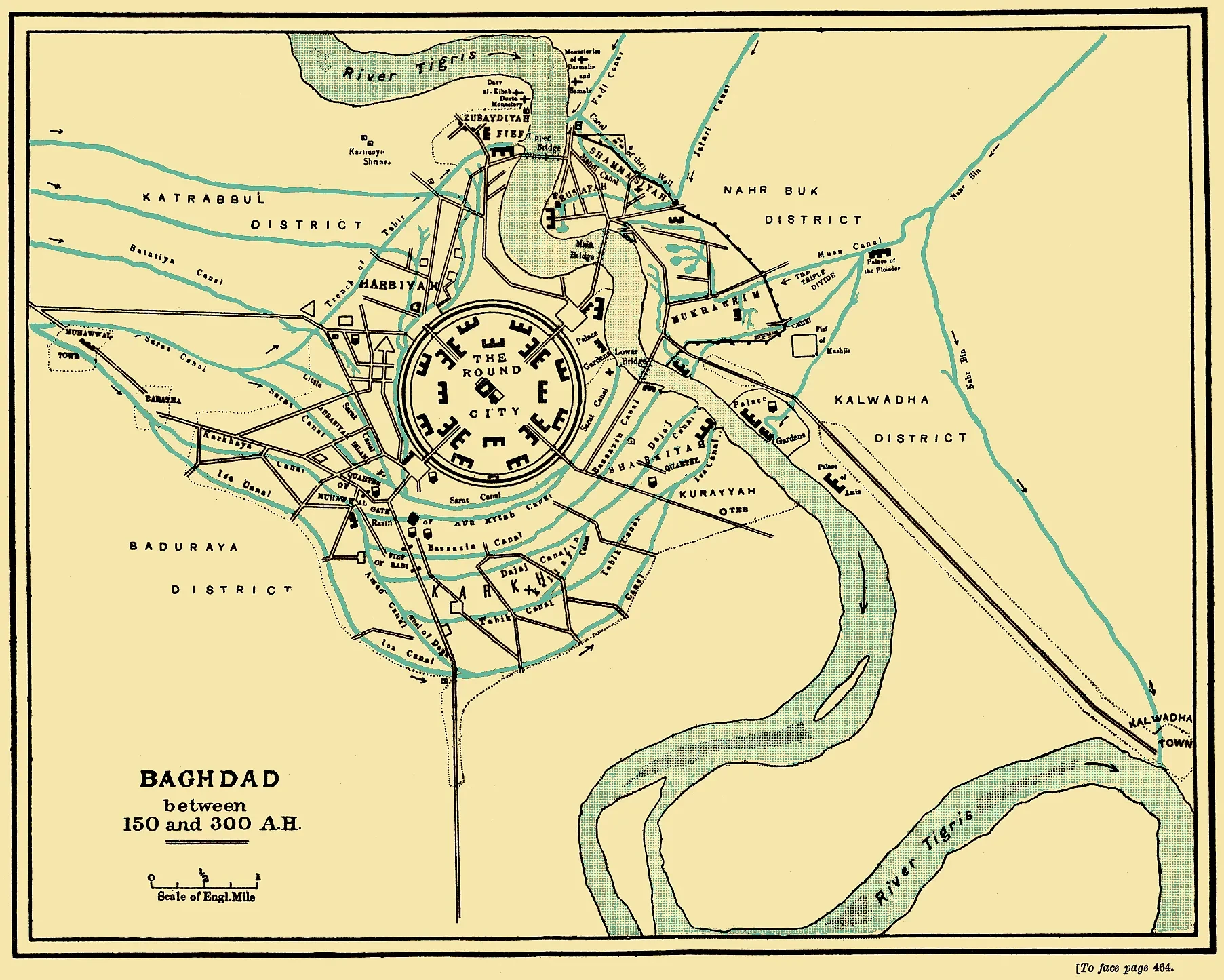
William Muir, Public domain, via Wikimedia Commons
The round city of Baghdad.
The place where the House of Wisdom is located...! A city that rose beside the ruins of Ctesiphon of the old Sasanian Empire! The hooves of the Mongols, alas... ㅠㅠ Hulagu, that scoundrel.
If it still remained to this day, it would be a city that would earn an incredible amount from tourism alone.
It would surely always rank among the greatest cities of its time, alongside Constantinople...!
The mental image is truly beautiful, but I couldn't include it due to copyright issues ㅠㅠ
Contrary to the typical image of a desert, it is a gorgeous city overflowing with water and greenery.