
145.
AD 867. Autumn.
West Frankia. Attigny. The palace of Clovis II.
"Try this goblet as well. It is wine sent by Solomon of Breis. I hear it came from the Roman Empire through the city of those Norsemen—was it the North Sea now...? In any case, is it not remarkable."
Carolus, or Karl. The King of West Frankia, or The Emperor, named after his grandfather, spoke indifferently and lifted his goblet.
A golden goblet engraved with a cross. The fingers grasping its elegant curves were thick and strong, and the eyes of Karl, gazing indifferently beyond the window left wide open, were unreadable.
"Indeed. It is truly remarkable."
Burgred carefully drank the wine in the goblet as the master of this old palace had bidden him.
His steps toward Rome, leading his beautiful wife and loyal warriors, had been halted by the lord of this land.
Robert the Strong of Anjou in western West Frankia, and here, a place touching the northwestern part of Lotharingia in eastern West Frankia.
Karl, who had spent time with his daughter in a place near Flanders, had summoned Burgred for all of that journey.
"Is it not so? It is no easy matter to broach before you, but at the risk of giving offense, is that man Helgi not a truly remarkable fellow? You must have seen it yourself, King Burgred, but in my land there are three frontiers, and I am hard-pressed merely to guard them."
The three frontiers Karl spoke of were the defensive zones for holding back Breis, the Norsemen, and the Muslims to the south.
Robert of Anjou, Baldwin of Flanders. And to the south, Conrad II, the powerful lord of Burgundy and a kinsman on Karl's mother's side.
West Frankia was thus forever encircled by foes, and it would be no false statement to say the life of Frankish royalty was a life of marching, fighting, and at last dying.
Though he had believed he had managed to forget, the memory of that day remained in Burgred's chest as if seared in with a brand, and he drank the wine once more.
The image of Helgi Ragnarsson pressing forward without hesitation, cutting down every last one of his warriors.
He had planned it meticulously, and it should have succeeded. The Norseman Konungr, who moved like lightning—or was it Fylkir now? By the strength of that single man, everything had turned to foam. His own sworn warriors, the kingdom, the House of Mercia that had reigned for so many years.
Come to think of it, he had always fought at an advantage, whether in numbers or in terrain. Yet the result had been defeat all the same.
'Just surviving was a blessing.'
When he recalled the sight of his wife Æthelswith weeping at the pitiful return of her own warriors, he could only feel gratitude for the generosity Helgi Ragnarsson had shown.
Swallowing his complicated heart along with the wine, Burgred could only muster a bitter smile.
A king of a fallen kingdom.
The Emperor of West Frankia, carefully observing that sight, kept updating his information on Helgi Ragnarsson in his mind.
'Neither Edmund of East Anglia nor Burgred of Mercia. Not a trace of vengefulness to be found. To have shattered even the will for a final stand—is he not a truly fearsome fellow?'
Royalty are usually those born into pride and living with a self-regard that borders on arrogance.
A man like himself, who had begun with a title as small as dust and seized a throne through blood-soaked battles with his brothers, knew how to modestly yield and step back. But those born as masters of great kingdoms ordinarily carried that peculiar pride until the moment of death...
Why, then, could he find not even a hint of it in those bested by Helgi Ragnarsson?
'It must be one or the other. Either Edmund and Burgred are weaker than I thought, or that Fylkir of the North Sea is stronger than I had guessed.'
The world was full of men who could fight well.
Not only his elder brother Lothar, who had now departed for heaven before him, but Robert, the Margrave of the West, was called 'the Strong,' and Baldwin, the Margrave of the Northeast and his son-in-law, was called 'Iron Arm.'
Thus, mere strength did not earn one the name of a true champion, and it was clear that Fylkir of the north understood this well.
'With this, I can be certain. It is the wisest course not to meet that northern conqueror face to face.'
Could he not use this another way? By sending him toward another member of my beloved family, for instance.
Now able to devise such schemes as naturally as breathing, Karl raised his goblet and drank the remaining wine.
'Solomon of Breis. I drank well of your Roman wine. And as I have understood your intent, I shall go along with it for the time being.'
To send wine from Rome, deliberately routed through the North Sea, as if it were a gift.
Solomon's provocations were growing more sly and grimy by the day, so the time would eventually come to take him in hand.
But his father's dying injunction had always been to deal with the task before his eyes first.
"King Burgred. King Edmund of East Anglia has gone to Rome. I have heard that the two of you are to each other much as I and my brothers were."
Desperate to kill each other.
"Might you not lend your aid to me, rather than going on about southern expeditions to that unreliable Rome?"
"I, lend aid to Carolus?"
"For example, how those Norsemen chiefly fight, and what more we might be able to do. You may or may not know, but the Muslims of the south continue to menace our good Catholic faithful. If you so desired, how would you like to begin again there? The post of Margrave happens to be vacant."
As he watched the king of a fallen kingdom struggle to readily answer, Karl set down his goblet.
Step by step, he would advance. Toward Aachen, toward Rome, toward Regensburg.
*****
"So all of this is the saga?"
"That's what I'm telling you! You'll never know how much trouble I went through, Helgi!"
This was a place a short distance east of Árós.
It was where the new school and library building stood. A broad building had been raised on a wide plot, and then the scholars had all been crammed inside.
Unexpectedly, the development speed—or rather, the pace of book production and all sorts of research activities—seemed vigorous.
Not that the research was anything grandiose: it was mostly feedback related to sieges, improvements to marching wagons, road improvements, and realizing blueprints coming in from Rome.
That nine out of ten—no, all of it—was war-related had to be said to reflect my personal tastes... I was in the middle of reflecting on it. I did have to make those damned sewer pipes...!
Anyway, amidst the busily moving multinational scholars, I was receiving a research progress report—the right of an investor—in Sigurd's 'laboratory,' which occupied the largest space yet contained nothing but instruments and parchment for writing lyrics.
As a newlywed and soon-to-be father who had also sat out this great expedition to Britain, Sigurd had been given a special commission by me: to gather and record all the songs existing in Norse society—that is, the sagas.
Because the faith of Norse society was deeply intertwined with these sagas.
In one village Tyr was mightier than Odin, and in another Thor was in fact the strongest. It had been a task ordered to unify such a multiverse of worldviews and establish a law...
But the volume was considerable.
The stacks of parchment, whose price had fallen somewhat now that supply was plentiful, stood roughly seven stacks, each as tall as a person?
I was at a loss as to when I might ever analyze this and somehow unify it all, but in everything, the first step was what mattered. Unexpectedly, Sigurd had little talent for composing lyrics or songs, but he did seem to have talent for this administrative work.
He had even categorized them into kings' sagas, legendary sagas, and chivalric sagas. And those were... annotations? He had also written down his own thoughts on the manuscripts.
'Hmm.'
"Here, look! Brother Fylkir! It is no exaggeration to say that everything of us Norsemen lies in these songs! Your own song is right here, too! It is certainly not one I made, but if you look at the words—"
"Sigurd. I knew you would succeed, of course."
"—the goddess Hel's... Huh?"
Sigurd had faltered at my sudden praise. Without missing this momentum, I issued a storm of work instructions.
"A vast undertaking like this is something no one in the history of the Norse has ever been able to do. My clever brother must realize what this work is the cornerstone for."
At my meaningful voice, Sigurd's ears pricked up, and the snake within his eyes seemed to dance.
"As you know, I brought the gods down. Sigurd."
"You shattered the boulder! Of course, that achievement became a song as well! One that I made!"
Didn't you say you were busy collecting material?
"Yes, exactly that. All of it was for the sake of rebuilding the faith in this land. How long must we hang the pitiful and innocent from trees upside down? We have no need of such savagery. The gods have no need of live animal sacrifices; they need only a sincere and grateful heart."
"Uh—"
The face Sigurd made seemed to want to ask, 'How would you know that?' but it soon acquiesced, as if he had confirmed that I was, after all, Helgi Ragnarsson. Though I wasn't quite sure why...
"So we are going to use the sagas to create a new mythology, Sigurd. I thought on it for days and nights, but there was only a single person suited for this task."
"... And that is me?"
"Yes. Sigurd 'Snake-in-the-Eye' Ragnarsson. Would you care to become the Konungr of poets, and once more establish the spiritual world of our Norsemen?"
"Hah—!"
As if an artist were suddenly struck by a thunderbolt of inspiration, Sigurd trembled.
Then, suddenly, he picked up one of the instruments scattered about and began to play.
[Ding- Ding- Diriding- Diding- Ding-]
A single tear rolled down his cheek amid the intensely passionate performance.
I hadn't exactly heard an answer, but this seemed as good as an acceptance, and so I carefully slipped out of Sigurd's 'laboratory.'
'Simple as ever, really.'
In a way, Sigurd might have been the easiest of all my brothers to read.
Should I say he was that pure-hearted?
At any rate, having succeeded in shoving off—entrusting—a huge project onto someone else, I felt somewhat lighter in spirit and looked around the spacious garden.
Fearing the building might have been constructed by Romans, the garden arranged in the center of the square plot was brimming with the fresh scent of grass.
The skin of the people debating here and there or hurrying about was white, whiter, or dark, giving me the sense that I was indeed changing something.
'What was I supposed to do next...'
Torbjörn, the current Captain of Cavalry and Guard, was good only at fighting, his secretarial skills approaching zero, so as I was trying to recall my next schedule, a messenger came running in a rush from afar.
"Fylkir! Fylkir Helgi!"
'You shouldn't run or make noise in a library...'
Since such rules did not yet exist, the other people naturally only looked at the messenger and me with eyes that were tense and curious.
"Calm yourself. What is it?"
At my composed question, the messenger answered in a thoroughly excited voice.
"A message from Jarl Hrólfr and Leon! They say they have finally found the stone you spoke of!"
"A stone...?"
What stone?
☆☆☆☆☆Reference Material☆☆☆☆☆
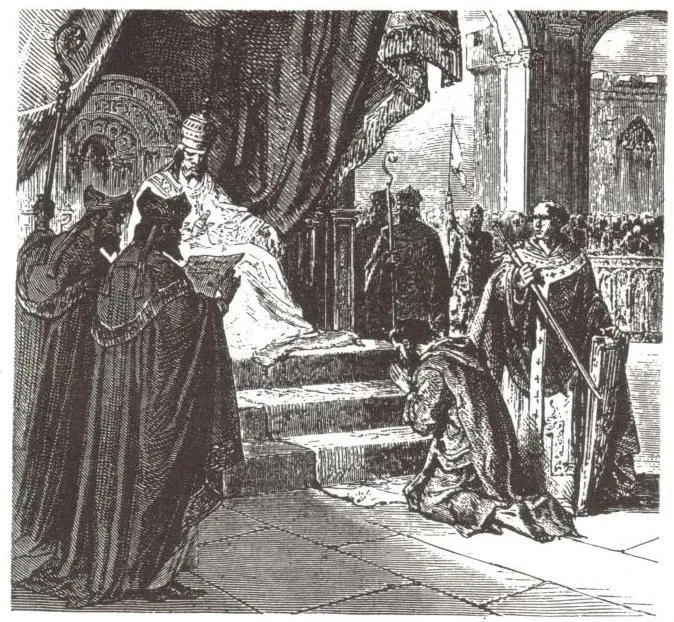
Public Domain.
Louis the Pious making penance at Attigny in 822. From the book "Généalogie des rois et des princes d'Europe", Jean-Charles Volkmann. Originally from "L'Histoire de France Populaire", Henri Martin, 1876.
This is a depiction of the court at Attigny...! The figure in the image is none other than Karl's father, Louis! The son of Charlemagne and the last Emperor of the Carolingian Empire...! After that, nothing but division...!
The court itself was built by Clovis II of the Merovingian dynasty... which is, in a way, an irony....!