
127.
Halfdan's 2nd Army was crossing the River Clyde.
My 1st Army also began its movement toward Glasgow.
'With fog this thick, we can't do anything.'
Could they see us moving from the fortress? They would probably catch glimpses of silhouettes, wouldn't they?
'But even if the diversion's meaning was lost, it wasn't bad. If visibility was limited to that degree, we'd fill half of those five rows of moats.'
The biggest problem with attacking Glasgow was not only that the fortress was a kind of twin castle with a large river between them... but what troubled my mind even more were those five long rows of ditches.
Indeed, moats were the textbook of defense. Gaels and us Northmen, Angles, Saxons, Franks, even Romans. The characteristic of those who built fortresses by raising artificial hills was that they dug moats well.
Those moats and palisades that had existed since clans fought one another in ancient times showed why the classics were classics. They were truly displaying the dignity of the classic before me.
Even if we somehow crossed the moats and stood before that flimsy-looking palisade, a palisade reinforced with thick timbers and packed with earth and stones between them would never collapse from mere axe blows.
In the end, what was needed were siege weapons, and I had two pieces of timber for a battering ram brought on wagons.
For Halfdan, who had crossed the river, the people of Kilmarnock would provide siege weapons and various needed supplies; and I had told Refil, who would move north to find a crossing if Paereogeos returned, to use local materials since he had no other choice... but I did not really expect a complete occupation of Peartoc.
The primary objective of Refil's force was to check any possible reinforcements from Alt Clut and to prevent Peartoc from fully supporting Glasgow and Cuban.
In the end, the crux of this battlefield was how quickly my 1st Army and Halfdan's 2nd Army could bring down Glasgow and Govan, those twin fortresses.
Therefore, taking advantage of the fog, I swiftly deployed the army and gave two thousand to Stórolf and two thousand to Guthrum to breach the moats before us.
At first, there was no response.
[puk! seuk- puk! seuk-]
War was soon digging. They set up shields as makeshift walls and worked hard behind them, digging up earth and carrying it away.
The soil was soft enough, and moisture-laden, so the shovels stabbed the earth without resistance. As they say, everything has its light and shadow. Who would have thought rainwater could help like this? That is why you can never know how things will turn out, isn't it?
And with the thick fog, the cheerful and vigorous sound of shoveling filled the dawn sky in a space where only hearing grew sharp, but Glasgow showed no response.
'I had intended to draw attention for Halfdan... but it turned out I was the one being helped.'
This was why diversionary operations were truly difficult.
Even more so in this world without radios.
In fact, it might be more desirable to call it a diversion but view it as a separate military action.
'Anyway, I should seize the opportunity.'
Since there was nothing more I could do about Govan now, I had no choice but to make the most of the time that Halfdan and the people of Kilmarnock had bought me.
Perhaps reading my impatience, Stórolf and Guthrum even took up tools themselves and joined in filling the moats.
Soon we began building a path straight toward the gate.
A somewhat muddy road, but enough for the wheels of a battering ram to roll over.
We filled the first moat, then the second. The further inward we went, the deeper they became, filled with murky water and traps beneath, but—
We were not draining the water but covering it over, so we endured and pushed on for half a day.
Finally, as the fog thinned, the garrison of Glasgow threw open the gate and charged out, but today the weather was not on their side.
With the sun even shining, our bows that had been napping in the supply crates finally began to see the light.
"Draw!"
[kiiiiik- kiiik-]
"Loose!"
"Fire!"
[pyung! pyupyupyung! sweaeaeak-]
The beautifully resounding sound of volley fire.
These warriors who had answered my call at Beodericsworth were originally heavy infantry, so I could not demand the same skill as the rangers of Huntadun; but what we needed was simply to draw and loose, sending arrows flying near the enemy's gate.
Since such basic ability was something every warrior under my command had to learn, the rest was solved by overwhelming numbers.
[sweaeaeak- sweaeaeak- pababak!]
"Urk!"
"Aagh!"
Riveted chainmail offered some protection not only against slashing attacks but also against projectiles, but the leather armor the enemy wore had weaker protection overall.
Especially against these crude arrows loosed from such large bows, it was almost like standing bare-skinned.
In a single volley, more than ten fell, and though the survivors returned fire as best they could, it was useless against our tactic of planting large shields in front, hiding behind them, and shooting arrows.
[hududuk- hudok-]
"Return fire! Loose!"
[pyung! pyupyung! sweaeaeak-]
Again, a rain of arrows embroidered the sky, and the defenders who had tried to hinder my army's overcoming of obstacles left the dead behind, barely dragging the wounded inside the gate.
With this single exchange, I became certain that a significant portion of the enemy strength meant to defend Glasgow had shifted to Govan.
Was it because of an excessive faith in the moats? Or was it a trap to draw us in? Giving up flesh to take bone...?
'No, they have not accurately grasped our capability.'
Swiftly reaching a conclusion, I ordered Stórolf and Guthrum, who were leading their forces up front, to push forward more boldly.
Having received the messenger's word, the two Jarls indeed began to push aggressively.
As expected, the fortress's counterattack was weak, and we crossed all five of Glasgow's moats, suffering occasional slips into filthy water or wounds from blind arrows shot from the walls.
No matter how well the ground was dug and jagged traps laid, in the end, a defensive position was meaningless without men to guard it.
Especially before me, with senses akin to a beast's sight, smell, and hearing, even traps hidden well enough to fool a seasoned hunter had to reveal themselves.
Having achieved the truly astonishing and unbelievable feat of neutralizing the enemy's defensive line in essentially a single day, as our army withdrew with the setting sun and took up Hugh's formation, two pieces of good news flew in at once.
*****
One day in the year 867, with half of summer already gone. Glasgow, northwestern Britain.
The night at the encampment, brightly lit with fires. Amid the bustle of ending a grueling day, two messengers moving hurriedly sought out the command tent.
One was a messenger sent by Boid of Kilmarnock. The other was a messenger sent by Refil, who had gone north.
First, Halfdan's 2nd Corps had successfully crossed the river.
As expected, the loose defense of Glasgow confirmed that most of their garrison had moved to Ghobhainn fortress.
What use was good terrain and diligent fortification? In the end, they simply lacked the numbers.
Of course, I heard that precisely because Glasgow's defenses were neutralized so easily, Halfdan and Djur had quite a hard time on the Ghobhainn front, but in any case, they had pushed back the enemy waiting on the hill and begun constructing their encampment.
The first step of the plan had been neatly executed, so I felt at ease.
The second piece of news was that Partholón and his friends had finally tracked down the traces of the enemy light infantry that had vanished into thin air.
Along with informing me of this, the 3rd Corps led by Refil and Oleg had moved out immediately, so they would have met Partholón by now.
If Refil and Oleg kept Peartoc well in check, then should the sieges at Glasgow and Ghobhainn not go as planned, we could simply starve them out entirely.
A fortress cut off from supplies and with no hope of external support was no different from a vast communal grave.
'Was it because of the extreme bad luck offset? The sieges themselves were progressing smoothly.'
Recalling the memory of walking along the damp, sodden river path made my whole body itch even now. And why were there so many mosquitoes?
I shook my head hard to banish the horrible memory, offered warm water and modest food to the two messengers who had worked so hard, and then left the command tent with Thorbjörn, who was serving as my bodyguard captain in place of Stórolf, who was about to properly assume the role of a commander.
My cavalry had secured the opportunity for decisive victory in East Anglia and Mercia, but here their treatment was merely that of rear-area supply guards and horse handlers.
It was regrettable, but with this kind of ground, there was no help for it.
According to what Partholón and Boid said, in the worst cases the land stayed like this all year round, and in winter snow fell instead of rain, turning it into an even worse mess, so I had resolved to utterly finish off both Alt Clut and the Kingdom of Scotland by the end of this summer no matter what.
My steps, having left the tent, came to a halt near the center of the encampment where a constant hammering sound rang out.
[Tock! Tock! Tock! Tock!]
"Now— hold that spot! Lift on three! One— two— three!"
"Hup!"
"Heave!"
Here, Stórolf and Guthrum had come out in person, lifting the timber for the battering ram and busily working on constructing siege engines with great fervor.
Once the large, rounded, and long-trimmed log was capped with an iron cover bent into shape and properly hung on the pre-assembled wooden frame, it was about half complete.
Now once a sturdy roof was placed on that frame and covered with several layers of leather, a fairly solid battering ram would be finished.
'Of course, the enemy isn't stupid either, so they'll have reinforced the gate. We might really have to hammer at it all day.'
That was the fight of normal and ordinary people. What I needed was just a slight opening.
"Good! Now bring the wheels! Will this thing be able to roll across that mud field?"
"We have made several in advance! If one breaks or collapses, we can simply replace it!"
"True words! Men themselves stumble here, how could a siege engine be any different? I suppose there is nothing for it but to prepare many spare boots."
Stórolf, Guthrum, and the warriors of East Anglia and Dair worked diligently at their tasks while exchanging opinions back and forth.
Hearing the Norse language gradually becoming mixed into the tongue they spoke, I did not go forward to draw attention, but instead headed toward where the horses were kept with Thorbjörn.
I had to show my face to Camembert from time to time, as he was merely lazing about out of boredom.
Even when there was no battle like this, my schedule was busy.
*****
The morning after building two fine battering rams from sturdy, thick-grained timber.
The fog that had thickly shrouded the surroundings even until the dawn when I fell asleep had vanished.
For some reason, the sky was clear without a single dark cloud.
'Does this mean if I'm going to fight, I should fight today?'
Amid the laughter escaping me at the sky's prank, as if it were picking the day of battle for me.
Since favorable conditions must be exploited in any case, I ordered the army to march out, and an unfamiliar sight caught my eye.
It was the riverbank stretching out to the left of Glasgow fortress, which we were attacking.
Some boats and people who had disembarked onto the riverbank at a little distance were loitering there, craning their necks this way.
At first, I wondered if reinforcements from Alt Clut had arrived, but the words the scouts I hastily sent out returned with were different from my guess.
As it turned out, they were people living nearby who had come to watch because they heard a big fight had broken out.
"To watch...?"
Having summoned the commanders before the full-scale attack to discuss the identity of these new uninvited guests and our response, I could only let out a baffled laugh.
"Well, this means we cannot show any disgrace today! I shall be the first to break through their walls! Konungr!"
"Hm— Jarl Stórolf. I had not intended to bring this up, but did you not meet a certain woman back in East Anglia? She often asks me for news of Jarl Stórolf..."
"No, Jarl Guthrum! Why does that story come up now...!?"
"Oh ho—! Jarl Stórolf! Do you intend to cast aside the lady's honor like a worn-out shoe! Of course, if you yield the honor, I shall pretend I never—"
I was incredulous at the news that we had spectators, but these two seemed rather excited by it.
Come to think of it, were we not Norsemen, who even in the midst of this war paid attention to our appearance with toothpick-like tools for cleaning under fingernails, small knives for grooming beards and hair, and combs?
Truly, a sight that could be called medieval attention seekers.
Shaking my head slightly, I called Stórolf and Guthrum to attention.
"I will lead this battle personally. The moment I see an opening in the enemy, I will charge straight in, so you must prepare thoroughly. Understood?"
"Yes! Konungr!"
"We shall follow!"
The two Jarls answered my command instantly while still casting sidelong glances toward the place where the spectators had gathered.
In the end, I laughed heartily at that childish behavior and advanced the army.
☆☆☆☆☆Reference Material☆☆☆☆☆
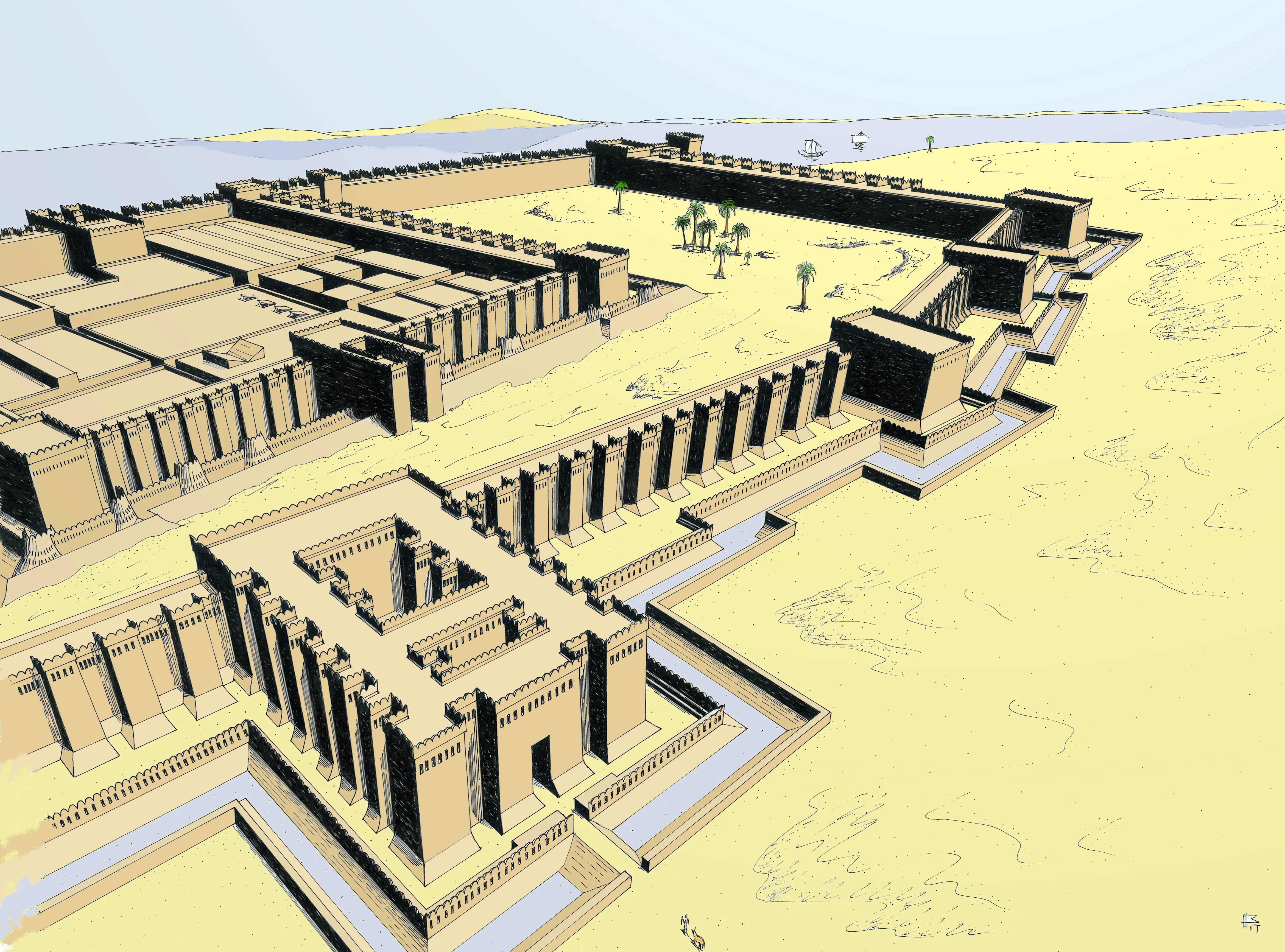
Franck Monnier (Bakha), CC BY-SA 3.0 <http://creativecommons.org/licenses/by-sa/3.0/>, via Wikimedia Commons
1200 BC.
?
1200 BC lol This is an artist's reconstruction of the ancient Egyptian fortress of Buhen. It was made based on the actual ruins. You can see the moat.
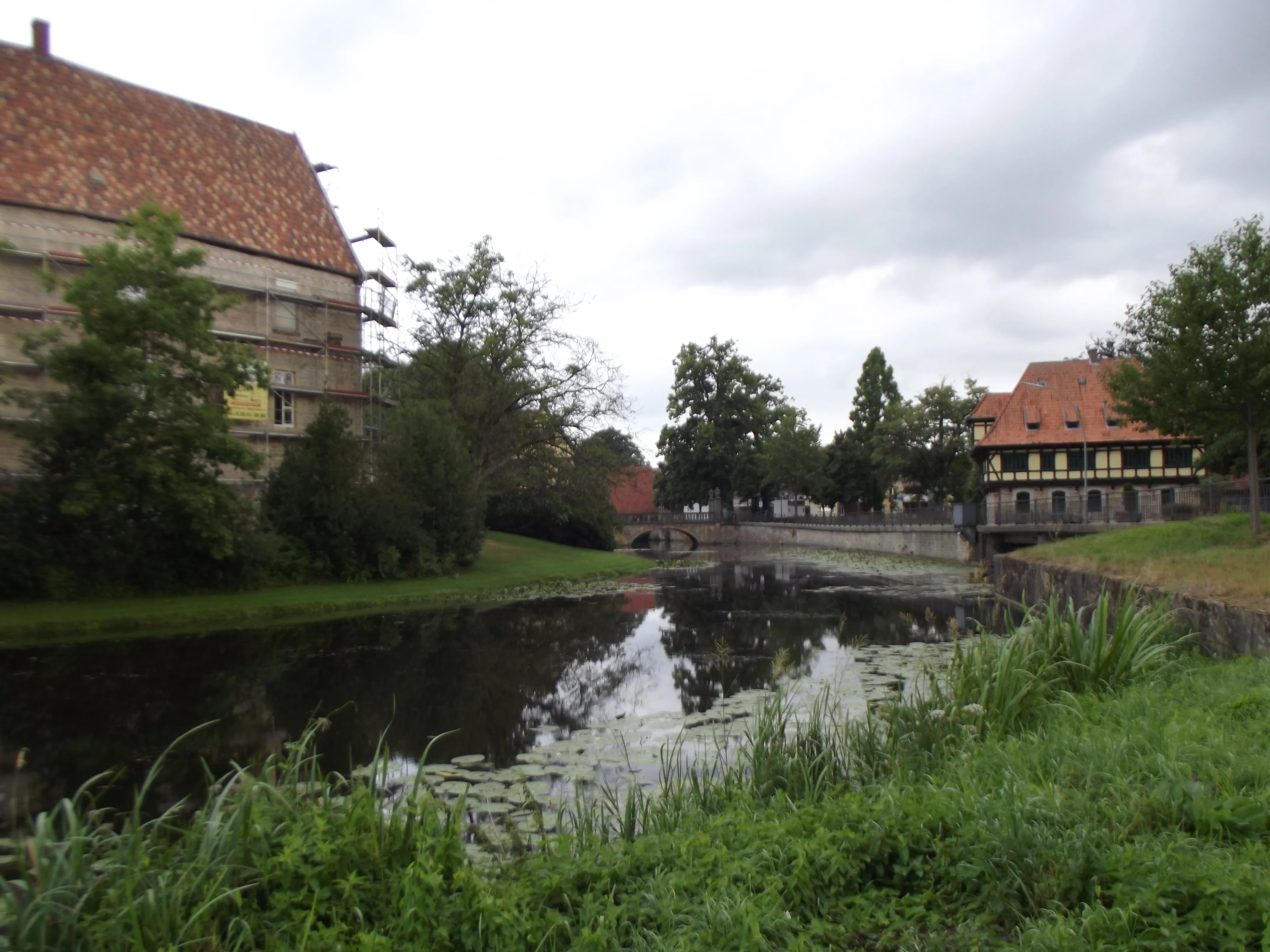
NordhornerII, CC BY-SA 3.0 <https://creativecommons.org/licenses/by-sa/3.0>, via Wikimedia Commons
This is the moat of Steinfurt, Germany.
It seems moats were basically used by any people who had the skill to dig into the ground hehe.
But as described in the story... in the end, they only have meaning when defended by people... so they were never an invincible obstacle.