
124.
Even the same javelin flew so differently depending on who hurled it.
[Fwooong— thwack!]
"Urk!"
[Shuk— shushuk— pabak! tang!]
"Throw axes!"
[Hwoong— hwoohwoong— hwoong— hwoong— pababak! peok!]
"Khoff!"
"Aaargh! My shoulder!"
"Run away—! Run!"
Already the fifth one.
Five of my throws, and exactly five foes had fallen.
Unable to endure this absurd exchange any longer, a handful of the boldest ones among the enemy light infantry— their pale skin thoroughly flushed red— had charged into the throwing range of my warriors.
And the starving wolves who had been biding their time instantly snatched the hand axes from their belts and hurled them in a single volley.
Beneath dozens of axes that seemed to fly even heavier than javelins, about ten of the enemy collapsed in the blink of an eye.
"Anyone still got axes to spare!?"
"They're running again!"
"Get a hold of yourselves! Do not pursue the enemy!"
"Stand your ground!"
'Hoo-eup—!'
[Fwooong—!]
After hurling my sixth spear, I watched the fleeing foe— their behavior utterly unlike the cautious movements they had shown so far— now turning their backs and bolting.
[Fwoooong— peok!]
"Aaargh!"
The scream of a comrade who had caught a javelin in the back drove the enemy light infantry to flee as though possessed.
'Brave little sunfish bastards...'
Quietly observing them, it felt as though their individual warriors, when you broke down their capabilities, suffered from a low total quantity of 'sagi'— what is commonly called 'morale'.
Thinking of how they would flee like that and yet return the very next day, or perhaps that same evening, as if nothing had happened, they were not cowards; rather, they collapsed quickly and recovered unbelievably fast.
In short, it meant they were terribly troublesome opponents.
'I need to move as much as the time I've bought. I wonder if the weather will cooperate.'
"Seutorolpeu! Guthrum! We advance! Glasgow will soon be in sight!"
"Yes, Konungr!"
"Understood, my lord! Did you all hear the Konungr's words! Sound the horns! We advance!"
"Warriors of East Anglia! Move out!"
"Dair! Forward!"
[Buuuung— buuuung—]
[Cheok! cheok!]
All around, the rough voices of the captains— each commanding thirty, sometimes up to fifty men— and the clamor of war horns rang out noisily.
My army, which had swiftly reassembled its scattered ranks, began to move as one. At last, Glasgow was not far off.
*****
A full week's march from the upper River Clyde.
Half of that— four and a half days— had been harried by enemy attacks. It had been a truly grueling campaign.
'If there is a stroke of fortune, it's that the rain has quieted a little...?'
In a situation far from pleasant, I had to ferret out every possible advantage.
The ground was sodden, no usable timber was in sight... and what was worse, every bridge I had seen on the road to Glasgow had been entirely destroyed. The wooden ones and the stone ones alike.
'This is going to make crossing the river a real ordeal...'
Gazing at the River Clyde, rendered utterly unfordable on foot by the deluge that had poured down for a full seven days, I first sought out the highest, broadest hill I could find and ordered the establishment of a camp.
Soon, in this space where pale sunlight now drifted in and out through thinning clouds, the sounds of bustling cart wheels and hammering mingled with the noises of men working hard, laughing and chatting between bouts of labor.
I had posted sentries in all directions in case of a sudden enemy attack, but no javelins came flying today. Did they simply not operate unless it rained?
As if they were some kind of fish— surely that couldn't be it. More likely, they were now moving to target the forces of Halfdan and Refil who were trailing behind us.
After all, they would know our destination was this place, and they would be trying to inflict as much damage as possible. Yet, judging by the attacks I had experienced from them, while this guerrilla skirmishing of theirs might prove brilliantly effective at tormenting people...
In the end, it could not pierce the solid defense of my army.
'If things go badly, I might genuinely have to build a palisade behind me while besieging the enemy fortress in front.'
The legendary battle of Caesar and the Roman legionaries that had come to mind as we entered this Kingdom of the Canyons.
My eyes, imagining the worst-case scenario, were fixed unwaveringly on Glasgow.
The gloomy walls suited to a grey world, and the watchtowers beyond them.
It was a fortress reminiscent of Kyiv— a high earthen motte raised upon packed soil, ringed with stout wooden palisades. I could not even guess how many moats they had dug; the defensive line, resembling the dense contour lines of a map, sent chills down my spine.
The one consolation was that while the moat nearest the wall looked quite deep, the rest were not so profound? But they were all brimming with water, which meant crossing them was bound to be a monumental headache...
"Alright, one— two— three!"
"Heave!"
"Hyah!"
How many times over the past seven days of foul weather had we pitched camp only to break it down again?
All that experience had seeped into them. My engineers— no, my warriors— were now so adept at pitching tents and digging drainage ditches that within barely an hour, they had constructed a camp that looked rather respectable.
They leveled the ground with the earth dug from the drainage ditches, picked out the stones, raised the tents, and drove the timber posts we had brought along to mark the perimeter.
Regrettably, any decent lumber in the vicinity seemed to have been entirely consumed in building the walls of Glasgow; all that remained visible were wretched, scrawny trees. But even those they cut down to fashion into palisades.
In this makeshift manner, within two hours, a nest for our army in this campaign was created, and the warriors entered Hugh's rest all at once.
Today's rations: hardened bread chunks, salt-cured fish, and thick, dark ale.
Beautiful memories of Constantinople surfaced— of drinking wine with olives bobbing on its surface. But fortunately, I possessed the talent of eating everything deliciously without being picky.
Seutorolpeu and Guthrum, who had labored and sweated alongside the warriors until the work was finished, came to my side and ate together with me.
"Truly, they are loathsome wretches, Konungr. Fighting in such a petty, underhanded manner..."
Guthrum, a true man's man who had just stuffed a whole salt-cured fish into his mouth with dirt-caked hands, grumbled to me.
At his sudden outburst of lavish praise— or rather, censure— for the enemy, Seutorolpeu, who had been gulping ale beside him, laughed and choked on his drink.
"*Hack hack*— *Khek!*"
"It would have been the best course for them, Guthrum."
"Yes, Konungr. The Konungr's words are right. Who would want to face a host of this size? Especially one led by the Konungr himself. Still, it is infuriating!"
"*Kek!* *Kup!*"
"Eat slowly, Jarl Stórolf! It is all splashing out!"
After finishing the fish, Guthrum immediately chewed on the hard bread as if he had a vendetta against it.
I, having handed water to the still-coughing Stórolf, found myself laughing at the sight but still pondered Guthrum's words.
"A great host, eh..."
Twelve thousand heavy infantry.
All armed with riveted mail, helmets, and good-quality spears and swords. I had changed the shields from the traditional round ones to the large, rectangular ones borrowed from old Roman legionaries.
There was a saying that the trees in Árós grew faster than they were cut, so wood was not a precious resource for us.
'There is no good wood here even if you looked closely.'
Anyway, if a force of this size went over to the Eastern Roman side, they would just say 'Oh, you brought a few lads?' But here, in northwestern Britain, it became 'Oh, good God. Twelve thousand heavy infantry...? We won't fight.'
To fight and win against enemies holed up behind hills, rivers, and walls, siege weapons were needed... but with the road such a morass, just dragging the siege weapons built in Edinburgh here would take an age.
Worry deepened in my head, and when Stórolf, finally having stopped coughing, carefully set the leather water bottle down while watching me, I was lost in deep thought.
Guthrum, who had by now polished off every last crumb and was even savoring the thick dregs of his ale, narrowed his eyes and rose from his seat.
[Swish—]
"What in the...?"
"Hmm. What is the matter, Jarl Guthrum?"
"Jarl Stórolf. Is that not a boat?"
A boat?
"What boat do you mea— Oh, truly. It is a boat."
The two jarls likewise rose from their seats and peered far across the River Clyde, along whose bank we had been making our way.
My eyes snapped wide at their words, and I hurried to my feet to look out at the sunlit River Clyde.
The proud waters glittered as they caught the first golden sunlight in many days.
For the past seven days, rain had fed the River Clyde heavily, and now, upon its swollen current, dozens of boats—slightly different from those of the Northmen, much smaller and nimbler-looking—were descending with oars.
"Stórolf, Guthrum. Put the warriors on alert."
"Yes, Konungr!"
"Understood!"
The two jarls, who had been watching the drifting boats in distraction, hastily vacated their spots, and the camp, which had grown calm during the meal-cum-Hugh meeting, grew bustling once more. Meanwhile, my raptor-like eyesight showed me the lead boat as it drew ever closer to the riverbank.
'Fearghas?'
The man who had been absent to make contact with Clan Erskine, the avenger of Dull Blann, was there.
*****
"Greetings! Strong Konungr! I am Boid ap Wallace of Kilmarnock!"
"... You may call me King. Boid ap Wallace. I am Helgi Ragnarsson of Árós. It is a pleasure to meet you."
"Oh, the honor is mine! King Helgi! Although he was a pagan ancestor, to meet a warrior called the reborn Cú Chulainn is an honor not just anyone can enjoy!"
Come to think of it, these people were Catholic too, weren't they?
The people around here showed no sign of it at all, so the reality of it never truly sank in.
I had to admire the influence of the Catholics... but its shape varied so drastically from region to region that I could begin to understand why countless different sects would later emerge.
"It is regrettable that my current circumstances leave me unable to offer you proper hospitality. Yet, I could not contain my curiosity—how did you get word and come with reinforcements so swiftly?"
It had been a mere five days since Fearghas—who stood quietly behind Boid of Kilmarnock and the Gaelic warriors he had brought—had departed.
No matter how well Fearghas knew the local geography and how light his step, there was still the matter of physical distance.
"Haha! Would we, who make islands on the water's edge, travel this land on foot? The River Clyde has many children, and one of them reaches a loch near Kilmarnock, allowing us to move in an instant."
I see.
Indeed, a great river like this always had its tributaries. These were truly complex waterways that only a native of this place could know.
We had been guided only along the main river by Fearghas and had thus reached Glasgow.
"And, in truth, our preparations were already complete. We did not know that King Helgi himself would come, but the very moment we heard that the Northmen's army had left Edinburgh, our clan steeled its resolve. The resolve that the time had come for the throne of Alt Clut to meet a new master."
This red-haired, blue-eyed Gael's eyes glistened even beneath the gray weather that was once more hiding its face.
"The old men of Alt Clut and their old bloodline hole up on that damned rock, turning their heads away from the world, but we of Clan Erskine always keep our ears open to news from the east. How could anyone stand against the Konungr—King Helgi—who has already toppled the mighty Northumbria, Mercia, and East Anglia?"
Those were probably the surface reasons; their real motive was no doubt something else.
I chose not to poke at the scab.
"To King Helgi, who is already called the second coming of Cú Chulainn, we wish not to offer a sword, but a path."
"A path?"
"Yes, King. Wherever the waters of this River Clyde reach, we will ferry you, the King, and these mighty Northmen warriors."
I had thought they were reinforcements, but something even better had arrived.
A taxi— no, a bus had arrived.
☆☆☆☆☆Reference Material☆☆☆☆☆
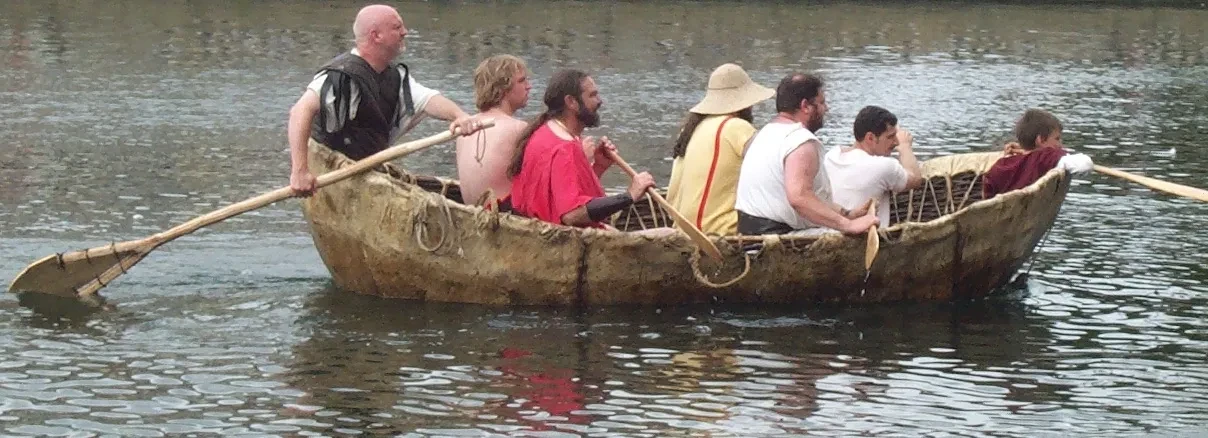
Simon Speed, Public domain, via Wikimedia Commons
An indigenous Irish boat. A curragh.
It's a hide-covered boat lol.
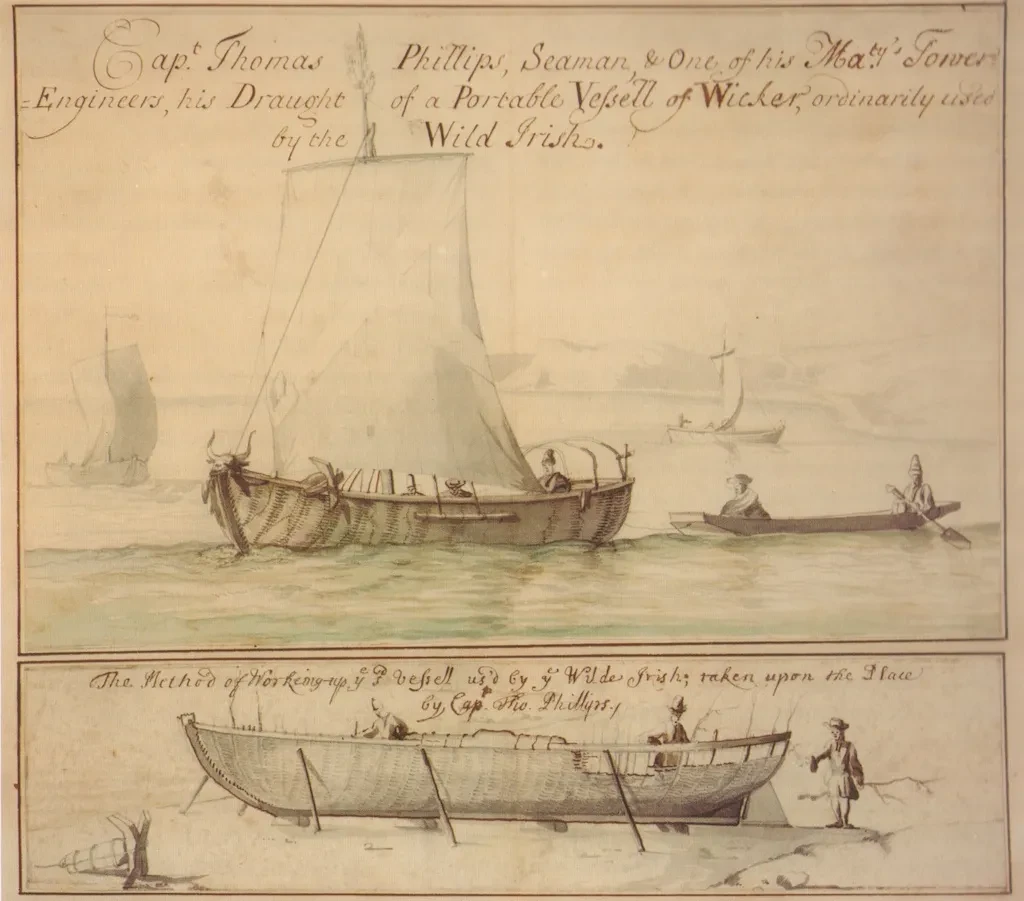
Captain Thomas Phillips, Public domain, via Wikimedia Commons
This is the over-technology vessel used by Captain Thomas Phillips, capable of long-distance ocean voyages...!
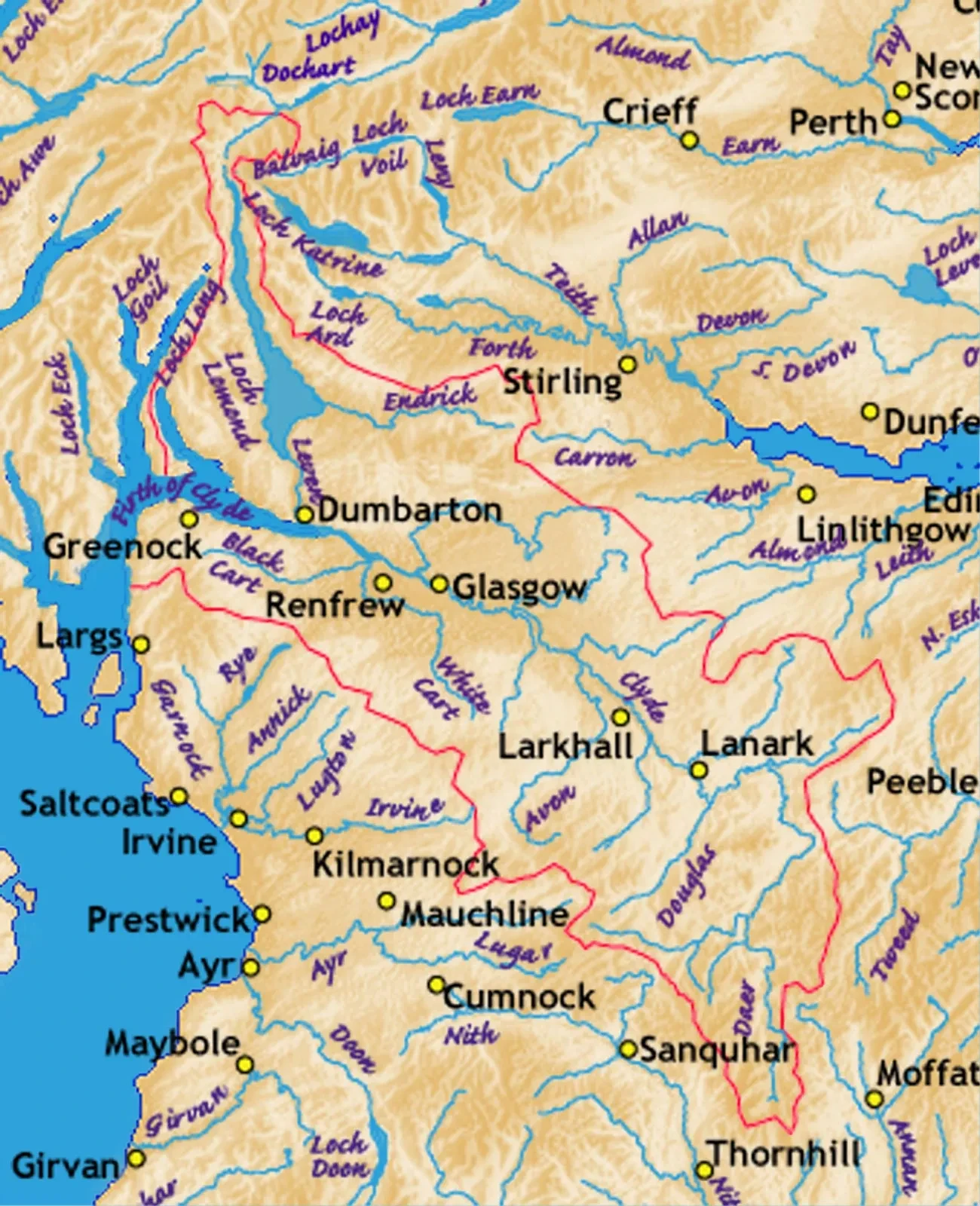
author of source image, plus my modifications (myself), CC BY-SA 3.0 <https://creativecommons.org/licenses/by-sa/3.0>, via Wikimedia Commons
A reminder of the bewildering waterways of the western Scottish Lowlands...!
You can see Kilmarnock below Dumbarton...!