
I Sell Goods from Another World
After that, online sales proceeded without a hitch. The exchange and return requests that cropped up only very occasionally I brushed aside as nothing unusual—those things happen everywhere. Most of the buyers were people who'd purchased on their own and gotten caught by a wife or family member, or folks whose finances had suddenly soured and who needed to cut spending wherever they could.
Along the way, I learned the age breakdown of the people buying my weapons, and I remember being surprised by how young they were.
Buyers in their thirties and forties formed the largest share, with plenty of twenty-somethings behind them. The fifties-and-sixties crowd I'd actually been counting on barely bought at all. I wonder if they'd bite on an Eastern-style blade straight out of a martial arts novel?
In any case, since I didn't accept exchanges, everything was processed as a straight refund, and there was no need to bring the returned goods back to Humson.
Or rather—I made a point of not bringing them back.
Humson and that damn perfectionist streak of his would flare up all over again at the sight of them. He couldn't bring himself to accept a returned piece as his own work, and even though the returns had nothing to do with the quality of the craftsmanship, he would halt every other task and stay up all night poring over the returned weapons, hunting for flaws that weren't there.
Well, the designs were already perfect, so the only thing to judge was whether any fine scratches had appeared in transit. If it looked fine, I'd wipe off the dust with alcohol and list it straight in the returned-goods corner. If the edge had picked up a few light scratches, I'd sneak into the workshop while Humson slept and give it a few rough passes on the whetstone—after which they'd vanish without a trace. Returned items could be had at five percent off even without a coupon, so the moment they went up, they sold.
Less a problem than a regret, really: the biggest thorn in my side was that the products weren't stamped out in some factory but made by one man alone, which meant stock was never plentiful once the earliest days of the shop were behind us.
As word of the quality spread among the enthusiasts, I had to keep a SOLD OUT banner hanging over the listings, and every time I did, complaint-laced comments from customers waiting on restocks would run several pages deep on the review board.
For a merchant like me, that was a bigger source of stress than you'd think. People were offering good money, and I couldn't sell them a thing because there was nothing to sell. And underneath it all, the nagging fear: if I didn't get product into their hands on time, wouldn't they grow disappointed and drift away for good?
Then a thought came to me.
If I brought in more hands and widened the production line, couldn't I make a fortune?
There was no rule saying every last step had to be done by one man alone, was there?
With that thought in mind, I went to see Humson one payday. I hadn't hired him as an employee, but as a business partner—at his own request, I handed him his allotted share of the proceeds from everything sold, in person, every Friday. So I simply called it his weekly pay.
Along with the money pouch holding Humson's pay, I prepared a special gift: a box of Bacchus, that taurine-and-caffeine-packed restorative tonic.
In the modern world, Bacchus counts as essential gear for anyone who works in sales. Back when I had to make the rounds visiting clients, I used to buy it by the case and stack the boxes at home. Open a box, pull one out, crack the cap, hand it over—and once the other person had drunk it, not a soul ever refused my request. At least, not in the modern world.
With everything prepared, I broached the subject carefully.
"Master Humson. Isn't it hard, working all alone like this?"
"What nonsense! I've never once worked alongside another soul in my life. The moment another pair of hands touches even one step of the process, mistakes are guaranteed!"
Humson checked the contents of the pouch, nodded in satisfaction, and turned back to the nearly finished dagger—then his eyes landed on the box of Bacchus in my hands.
"What's that?"
"Ah, this is... an energy drink. You work yourself to the bone, so I thought it might help you keep your strength up..."
"Energy... what? Some manner of magic potion? Give it here."
"It's not a magic potion, but... it's close. You'll feel your strength come back once you drink it."
I hurriedly tore open the box and passed him a bottle. Humson turned the Bacchus bottle over and over, apparently fascinated by its shape.
Ah, right—I'm supposed to open it for him.
"No need. I know plenty well by now how you folks in your country return your bottles to be refilled."
Sure enough, marveling at the novelty of the thing, Humson bent close and studied the mechanism at the mouth of the bottle with great care. He was probably the only person in this world who'd show more interest in the packaging than the contents.
I tried again, carefully.
"The thing is... now that I've kept this business going for a while, a lot more people have been looking for our weapons lately..."
"Those half-baked things with no edge to them? Hah, honestly. Live long enough and you see everything. How do they plan on preparing for war carrying blades that can't even cut..."
Working alongside this dwarf, I've come to understand him. For all his grumbling, right now Humson was thoroughly delighted by what I was telling him. He'd probably already noticed how much heavier the money pouch had gotten.
Otherworld currency being metal made it heavy and unwieldy—not my favorite thing—but at moments like this, it was a joy. Profit became something you could feel, instantly, in the weight of your hand.
"Maybe that's why we keep having one sellout crisis after another, and plenty of people complain about how slow the weapon supply is."
"Complain? Listen to them—bellies full and still whining. Let them complain all they like. No waiting, no reward. That's the way of things!"
"Well, it's just... everyone's equally eager to get their weapons as soon as they can..."
"Oh, are they? Then how did they fight before, hm? With rusty fire pokers? With broken hoes and rakes and brooms? The weapons I make are on an entirely different plane from those worn-out farm implements!"
Mmm... I'd known this wouldn't be easy. Humson already nursed a grudge over having the edges ground off his creations in the first place.
"...Still, I think it'd be worth scaling up the simpler stages of the work. Your finished stock has run completely dry, and you're forging new pieces around the clock, aren't you? Hire someone else for the simple tasks—pouring the casts, hammering out the rough shapes—and keep the fine detailing for yourself, Master. If you brought on one or two people with forge experience, wouldn't that work out?"
"Not a chance in hell!"
Humson, mid-sip of Bacchus, shot the idea down hard enough to make the veins stand out in his neck.
Maybe caffeine drinks like Bacchus don't agree with him? Then again... for old-timers, caffeine sends the heart racing—too much of it really isn't good for the body.
"Pouring casts? Hammering? And you call that simple?! I knew you were a merchant who knew nothing about weapons, but I didn't realize it was this bad!"
Hm. He's angry. Yes, this is definitely anger. Unlike his happiness, Humson made no particular effort to hide it. I fired back before he could get the wrong idea.
"Of course it's important! That's exactly my point—if you took on just two good people capable of handling that important work, you'd finally be guaranteed some rest. You're working night and day as it is, barely sleeping at all."
"My body is my own to manage, so keep your nose out of it. And haven't I been meeting every delivery deadline you set, right on schedule? Quit grasping for more money and put that head of yours to selling properly made goods properly!"
And so it ended, with nothing gained. I had expected as much, to a degree. I kept trying to persuade him afterward, but Humson clamped his mouth shut as though he'd said his piece and threw himself into his work.
In the end, I had no choice but to keep every single listing on the sales site marked SOLD OUT. There wasn't so much as one dagger available for purchase. Sales, which had climbed in a steady upward curve, came to a momentary halt.
And during that lull, the problem I'd been dreading finally arrived. Word had apparently spread among sellers in the same trade, because cheap imitations of our weapons—similar designs, bargain prices—began pouring onto the market.
There were far more of them than I could count, and a wide variety, too. Bows, arrows, shields, javelins, throwing knives, two-handed axes, Eastern-style shuriken, clubs, morningstars—and what's this? Polearms? How do you even ship something that size? Does it come apart for assembly? Whatever. Noted, noted...
And it didn't stop at weapons. There were items that weren't mainstream weapons at all, wedging their way into the otherworld weapons category by sheer force. Whips, knuckle dusters, even a spiked dildo that looked like some adult torture implement—all of it listed as brand-new "weapon" arrivals on the shopping mall.
The copying didn't stop at products, either. The decorative weapon sellers who had held the niche before I ever started this business began imitating my sales approach too, forcibly slapping stories onto their listings—backstories that had never existed before.
Of course, in the modern world's free market, competition was fair game, and this sales concept wasn't copyrighted, so even if they copied me, I had no grounds to complain. By the same token, I had lifted my own stories from otherworld weapon history books.
But if you were going to imitate someone, you could at least put some original thought into it.
The Assassin's Dagger. The Assassin's Blade. The Assassin's Axe... The Knight's Longsword. The Knight's Two-Handed Sword... The Demon's Sword. The Demon's Bow. The Angel's Sword. The Angel's Two-Handed Sword...
That was just slapping labels on at random. Even a child could manage that much.
And what in the world were the +5 and +10 enhancement levels? They were sticking upgrade numbers on their products? Worse, the price changed depending on the level? What was the difference between +5 and +10 supposed to be? Oh, the color's different... One glance and I can tell—they've slapped prism stickers on plastic blades.
The quality of the competitors' goods was so laughable that I didn't even feel the sting of having my business niche poached.
But I did worry. If sales stumbled even briefly and our weapons got swapped out for those cheap things—value-for-money Chinese plastic blades—then the possibility of having to fold this whole venture couldn't be ignored.
So I toyed with the idea of selling some other otherworld item, something other than weapons to fill the gap, but I held off. The crafted goods used by nobles could serve as an alternative—jewel boxes, rings, necklaces bearing their distinctive patterns. They'd be out there if I went looking.
Being noble-exclusive, those wouldn't come cheap even in the otherworld. Still, if it meant satisfying the appetite of the customers who kept faithfully buying our products, then surely it was worth surrendering my margins...
No!
Now was not the time to expand the product categories. I had decided to become a weapons dealer selling otherworld weapons—so stay true to the concept. Don't rush. Trust Humson. Enthusiasts always circle back around to the real thing in the end.
For a while, those knockoffs served as the substitutes. I remember those days vividly—wringing myself with worry that my hard-won business niche would be stolen out from under me, spending each day glued to the shopping app on my phone.
But in the end, it had all been needless fear. No matter how closely they imitated, they simply could not match the finish and detail of Humson's work. What's more, those pieces were cast uniformly in factories, and the results still fell far short of his.
As one review after another declared that you get what you pay for, our products drew more and more attention with every new competitor that entered the field. At some point, the cheap Chinese plastic weapons quietly vanished from the sales app listings altogether. A consensus took hold in the medieval weapons community that nothing short of the genuine article should be sold, and the competition narrowed to about two sellers who maintained a baseline of quality. But even for those two, it was probably only a matter of time.
By now, I could say it with certainty. We—our products—were the benchmark. The classics.
The sellouts continued, but Humson had apparently been somewhat swayed by my words after all, because his production speed began to pick up. Every morning at eight sharp, he sent someone over with one dagger, one two-handed sword, and one one-handed sword—no exceptions—and I packaged them and listed them on the app at exactly nine. The instant they went up, they sold out again in under five seconds.
Humson and I have repeated that routine for about a year and a half now, every single week without missing a day. Saturdays, Sundays, and public holidays—holidays in both worlds, mind you—were observed as days off. I'm no ruthless merchant.
And so, little by little, we expanded the product line. We grew very cautiously, feeling out Humson's working capacity, so the lineup never became all that large.
Then, once the contract period ran out with the shopping app that had been skimming a fixed commission off every sale, I struck out on my own and built an independent shopping site. As for the site's name... I wanted to call it the Isekai General Store, but in the modern world I was still, for now, a seller of weapons. Once the categories grew, I could always change it slowly.
"Isekai Weapons Shop."
Three years on, by the time I had my current shop with its green roof on the edge of Greenhill's commercial district, I had added round shields, one-handed axes, and maces alongside the daggers, two-handed swords, and one-handed swords we already carried. Of course, those, too, still sold out the moment they were stocked.
"I'm glad we started out selling weapons."
I was content.
Even today, whenever I see the smoke rising without pause from the chimney of Humson's workshop as he works late into the night, I head home with the delivered weapons, satisfied anew each day by the thought that I had found a good business partner.
My only worry was that Humson might ruin his health. Dwarves, unlike humans, possess considerable strength and stamina—an old dwarf can work for a remarkably long stretch, and they say a short rest restores them quickly—but the unease remained all the same: my entire business could come crashing down at any moment in that craftsman's two hands. Though I suppose the same would be true in the modern world.
Time to shelve the pointless worries. All I could do for now was deliver Humson's weekly pay without fail, week after week, and keep an eye on his health.
This, too, is something I learned only later: when I first came to him, Humson had been on the very verge of bankruptcy. It wasn't a story you could hear with a straight face—and it came out one night, after the ordered deliveries had mostly wrapped up, when I brought a bottle of Cheoeumiseul soju, that smooth Korean liquor, and we celebrated over a beef dinner together.
"Alcohol? I don't touch the stuff! You drink something like that, and the hand holding the hammer shakes the next day!"
"What kind of fool bottles liquor in a green bottle? Green bottles are for poison and poison alone. That's common sense across the whole Middle Continent."
"And what's with this tiny cup? Something a babe would drink from? And is this even alcohol? Tastes like plain water to me."
That was definitely what he said at first—but after exactly one glass of Cheoeumiseul, he started tooting on the empty bottle like a flute and drained it to the last drop. Thank goodness I had brought only the one bottle. Otherwise he'd have drunk everything I carried in.
"This doesn't even register in the liver. Smooth and clean—it truly is like water. But there's a kick in it, all right! The people of your homeland are a remarkable lot!"
Humson had not been running a weapon shop there for very long at all. In the beginning, the place had been less a weapon shop than a seller of farm tools, hunting gear, and household goods.
That's right. Greenhill had not possessed a single proper weapon shop. The only ironwork the people here needed was farm implements, and the bladed goods on offer amounted to logging axes for felling trees, skinning knives for stripping the hides off beasts, and the butcher's and kitchen knives used for slaughtering cattle and cutting meat.
Humson had come to Greenhill at almost exactly the same point I had fallen into this world two years ago. He emptied every coin to his name to buy the old, cramped tool shop its elderly owner had all but abandoned, then packed it wall to wall with weapons of his own making.
Beyond the enormous pile of practice pieces, there were proper weapons even he could grudgingly acknowledge (and even now, those are genuinely staggering to behold)—but the real problem was that no matter how fine the weapons he sold, he had planted his flag in the wrong soil.
Worse, thanks to that thick dwarven pride of his, the moment a customer tried to haggle the price down even slightly or let slip any remark judging the quality of his work, he would refuse to sell them another thing and throw them out onto the street—just as he had on the day they first set foot in the shop.
And that day, his anger hadn't subsided, so he had kept the shop shuttered from morning to night. Not that a single customer would have come even if he'd opened it.
"But how did you get through two years with no income?"
"The humans in this town are low-grade. So I made low-grade goods."
And so, bending that stubborn pride of his just far enough to compromise with reality, he had survived by making and selling butcher's knives and kitchen knives—things he had never once crafted before.
When I examined them later, they cut far better than modern-world knives, let alone otherworld ones. Even a single kitchen knife carried a master's touch and was a different animal entirely—but the problem was the price: a full thirty silver coins for one knife.
To the people here, thirty silver was a sum approaching two to three months' wages. (For the middle class, that is.) No matter how cleanly it sliced meat down to the bone, almost no one in Greenhill would pour two months' salary into a single knife.
In a word, Humson had zero talent for business. No—a dwarf who should never have gone into business in the first place.
Meeting Humson was a stroke of luck for me—but it was a stroke of luck for him, too.
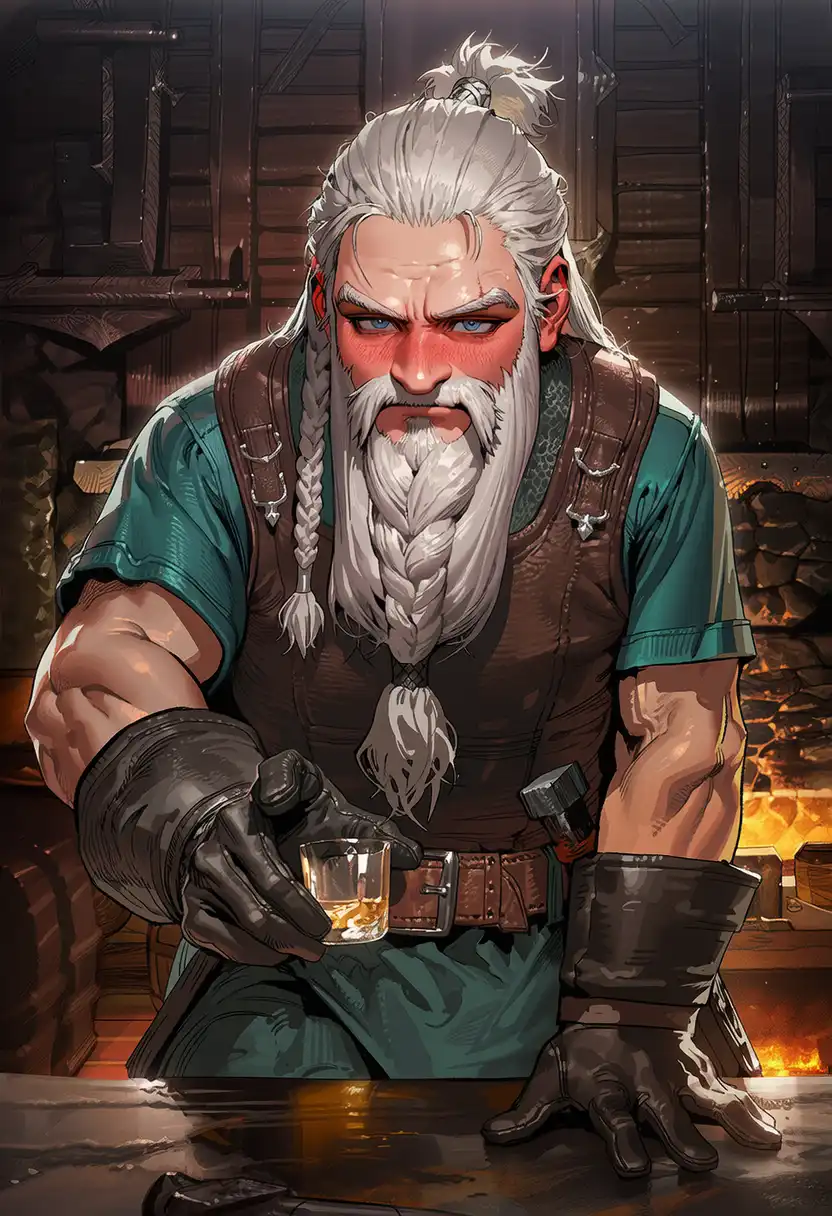
Before the drink could fully floor him, Humson bared his heart to me.
"Gathergold."
"Yes?"
"Thank you."
"For what?"
"Everything. For the extra pay you slip me. For the Bacchus. For this liquor... For seeing my weapons for what they truly are..."
"Thank me for what? It's all your skill, Master... Hm?"
He'd fallen asleep. Apparently he couldn't hold his liquor after all.
What still puzzled me was why, with skill like that, he had been driven out from among the dwarves in the first place.
Well, anyway. These days, this is how I earn my keep. With this money I pay the rent, pay the building maintenance, and buy stock to fill the general store's shelves.
That leaves a little won to spare on this side, too. I usually save what's left over, but I'm only human—if there's something I want, I buy it. This time around, I suppose I should pick up that pink version of the sexy maid outfit I'd had my eye on—for Erina to wear.