
Making Money Selling Otherworld Goods: First Candidate Item — Otherworld Top-Grade Organic Beef
Luciel, snack vendor of Greenhill.
After the snacks I'd first bought through an internet shopping mall scored a decent hit, my studio apartment had spent a while piled high with pouches stuffed full of copper coins, leaving barely any floor space to stand. Looking at them was satisfaction beyond words—but the real work started now.
Buying up modern goods that didn't exist in the other world and selling them here was one thing; keeping the business alive, though, meant I absolutely had to work out a way to turn the resources I earned in the other world back into modern-world money. If only there were some kind of dedicated currency exchange for the other world. Not that anything like that could actually exist.
At one point I'd even entertained the lazy thought: why bother earning won at all? Why not just pour my remaining won into hoarding otherworld coins and live off trading with those? But fundamentally, if it came to that, this apartment and I would be parting ways. Recent events had made that painfully clear.
In fact, steeling my nerve, I deliberately went three months without paying rent or maintenance fees as an experiment. And just as expected, no one ever came knocking to collect. If anything, I think I was secretly hoping someone from the modern world would show up—say, the landlord of this building, Rose House, arriving to announce that my lease was finished and I needed the room emptied by week's end. Then I'd seize his hand, shed tears of deep emotion, and declare: "You crossed dimensions themselves to come save me (collect my back rent)! Thank you, truly!"
Contrary to my hopes, exactly one thing changed. The very morning that third month ended, the electricity and water were cut off with razor precision. I leaned on that one little apartment for so much that it was a genuinely frightening experience. There was no landlord calling to hound me for the rent, but the dread that the cutoff might become permanent finally drove me to transfer the money in a hurry—and within five minutes, power and water were restored. An experience I never wanted to repeat.
Which meant that, one way or another, I had to earn money in the modern world too. Crypto and stocks were the most common approaches, and for someone limited to internet transactions, they seemed like the most realistic options available. But they offered me zero advantage. I had no particular knowledge or feel for that world, and one bad move could have stripped me of what little capital I had left.
So I kept coming back to one idea: somehow, some way, sell off otherworld goods. The answer had to be in there somewhere. What if I sold these coins? It was the first idea I'd had, and a fairly realistic one at that. I genuinely meant to try it.
Copper coins at the copper price, silver at the silver price. And if I ever got my hands on gold coins, I could fetch the gold price too. Even if they weren't worth what they'd be in the other world, I'd at least get the raw mineral value—and with metal prices on a steady climb, the income might only grow over time. Simple. And precisely because it was simple, an idea that made no sense at all.
When I actually looked into it, there were more dealers than I'd expected who took raw metal by courier, factored in market and appraisal prices, and deposited the payment straight into your account. Send the coins off with a copy of my ID and it seemed doable—this, I thought, was something I could genuinely pull off.
But pursuing the plan, I ran into several walls. First, copper coins—the metal I owned the most of—weren't accepted by most buyers at all. The few places that did take them required you to gather and ship copper by the kilogram to produce any meaningful sum, at which point the shipping costs outweighed the value of the metal itself.
Second, copper wasn't worth pocket lint, and silver left nothing over either. Even at a generous rate, 100 grams of pure silver came to around 500,000 won at current market prices—which, by weight, worked out to roughly three and three-quarter otherworld silver coins (tax not included). At that rate, I was better off simply spending the silver as currency in the other world, where it actually functioned as money. Of course, if mineral prices kept rising, I could always revisit the idea later.
But above all, third—and this was the biggest problem: the only genuinely profitable route would be to pile up copper and silver, convert them into gold coins, and sell those. Except the gold coins minted by the Kingdom of Helion weren't 99 percent pure gold. Yes, high-denomination currency like that was strictly regulated and properly minted by the kingdom—but this was still, at the end of the day, the Middle Ages. Their minting process naturally couldn't strip impurities from the gold the way modern refining could, and who could guarantee that otherworld "pure gold" matched modern pure gold in composition and density?
On top of that, Helion was rumored to be a country riddled with corruption, so even if everyone swore the coins were pure gold, the odds that they actually were were vanishingly slim. Beyond that, holding gold coins in the other world carried a value that went beyond simply being rich. So I'd judged that if I ever did come to own gold coins, it would pay better to keep them and enjoy the standing of a wealthy commoner—one of the upper-middle class—than to sell them off for their metal value in the modern world.
And finally. The decisive issue: how, exactly, was I supposed to ship a courier package from here... I couldn't type on a keyboard, couldn't make a phone call—how the hell was a package supposed to go anywhere...
Having concluded it was impossible, I'd spent the first several days in flat-out surrender. Then a thought occurred to me. Packages arrive here every single day—why can't anything go out? The boxes holding my orders make it all the way to my shoe cabinet by the front door, neat as you please, so why can't I send something back? In every other isekai anime or fantasy novel, this stuff was all covered in the tutorial, kindly explained step by step. For whatever reason, in my case, I had no choice but to slam into every last thing myself, from one to ten.
To test it, I first filed a return request on something I'd already ordered. The result: success. All I had to do was leave a box marked RETURN in the shoe cabinet area, and after a set interval, the box was gone. So outgoing shipments were possible, were they? In that case!
Emboldened, this time I slipped a letter into the return box as well. The gist: I'm in another world, some unknown force prevents me from leaving, and if you're reading this, please report it to the police and come to this address. Honestly, the most clichéd rescue request imaginable. (Looking back on it now, it reads exactly like something written by a raving madman...) Would it work? And if it did... could I actually be rescued?! And the result was...?!
Failure!
I waited for days, but the return box with the letter sat right there by the shoe cabinet. Even later, when a new delivery arrived, my box was neatly shifted aside and the fresh package stacked in its place. What this result meant was that, sure enough, some unknowable presence was opening and censoring even my outgoing packages, one by one. Like a prison guard inspecting every item delivered to an inmate.
So this time... I changed the approach. I prepared two shipping boxes and attached courier labels, both addressed to a grocery seller I traded with regularly. One held the rescue letter plus a single copper coin; the other was sealed with just the one coin inside. The point of including the coin was to find out whether sending otherworld objects to the modern world was even permitted. Then I set both boxes by the front door again.
The result?! One success. One failure. This time, only one box vanished—and as predicted, it wasn't the one with the letter tucked inside, but the one holding just the single copper coin.
Barring some reason I couldn't see, the package presumably reached the seller at the address on the label. A loyal customer suddenly mailing a single coin stamped with the portrait of some unknown otherworld figure—the poor seller would have had no clue what story lay behind it. He probably tried calling the phone number written on the box at least once, but of course, no call ever came. I hadn't expected much, but if even a single missed call had been waiting for me, I felt like that alone would have been a huge wellspring of hope... Whatever was controlling me had likely blocked even that.
To anyone else, it would have looked like I'd simply thrown a few copper coins away. To me, it was anything but—because the experiment had harvested a wealth of information. The conclusion: couriers worked exactly like the internet. I couldn't communicate personal requests or my situation to anyone in the modern world by letter. But routine purchases and returns were possible, and as long as I didn't slip in any personal commentary, I could send packages out for the purpose of selling. The money would land in my account either way.
So—was it possible to build an internet storefront for selling? I tried. It was! I'd taught myself just enough to build a crude one, but it worked, and I even managed to photograph a product (a copper coin), set a price, and list it. The more astonishing discovery: even though I'd never once been able to type a character into the network through my keyboard, I could fill in the product description field. As long as I didn't write anything personal, I could write text!
For an instant I had the feeling of someone watching me in real time from behind my chair, and a chill ran down my spine. Building my own sales site. And not only that—I could even register as an individual seller on a shopping app, list items for sale, and ship out orders. The app even let me complete the partnership contract entirely remotely, no contact required, over email—so apparently that part wasn't being controlled.
"Yes!"
Once I'd signed the seller's contract with the major shopping company I'd always used and the partnership was officially sealed, I flopped back onto my bed and shouted for joy. I can do this! I can make a living off this! I'll sell it all. Everything in the other world—every last bit, all of it!
... But seriously, what the hell am I supposed to sell now?!
I think I spent nearly a week agonizing over what to export back to the modern world. In an otherworld so closely resembling medieval Europe, anything I brought over was a jackpot. Even the hundred-won beer-flavored candies from the stationery store drove these people—whose brains had never once been pickled in refined-sugar dopamine—into a frenzy for just one more taste of whatever sweets I carried. I was the only seller in the other world who could offer these goods, so even when I slapped a 200 percent markup on them, that wasn't gouging. It was the fair, official otherworld retail price. If they didn't like it, they were welcome to make their own and try selling them.
But exporting back was a different story. Among the products of medieval Europe, what would actually stir buying impulses in modern South Korea? A Western ox plow for tilling fields? An axe for felling trees? An oak washtub for the village women's laundry? No answer came, and the frustration ground everything to a halt—for days on end I couldn't even run the snack stall, just sat in front of my computer monitor with a blank search bar glowing, wracking my brain.
Time to get out of here!
Then it dawned on me that sitting there would yield nothing, so I grabbed a pouch stuffed full of copper coins and stepped out my door. Even in this familiar other world where I'd spent over three years rolling around in cow dung, I figured a fresh look might turn up something I'd overlooked. The first place I went, naturally, was the market.
The market was at peak crowd, and it looked like a cow had just been slaughtered—a thick knot of people had gathered in front of the butcher shop I frequented.
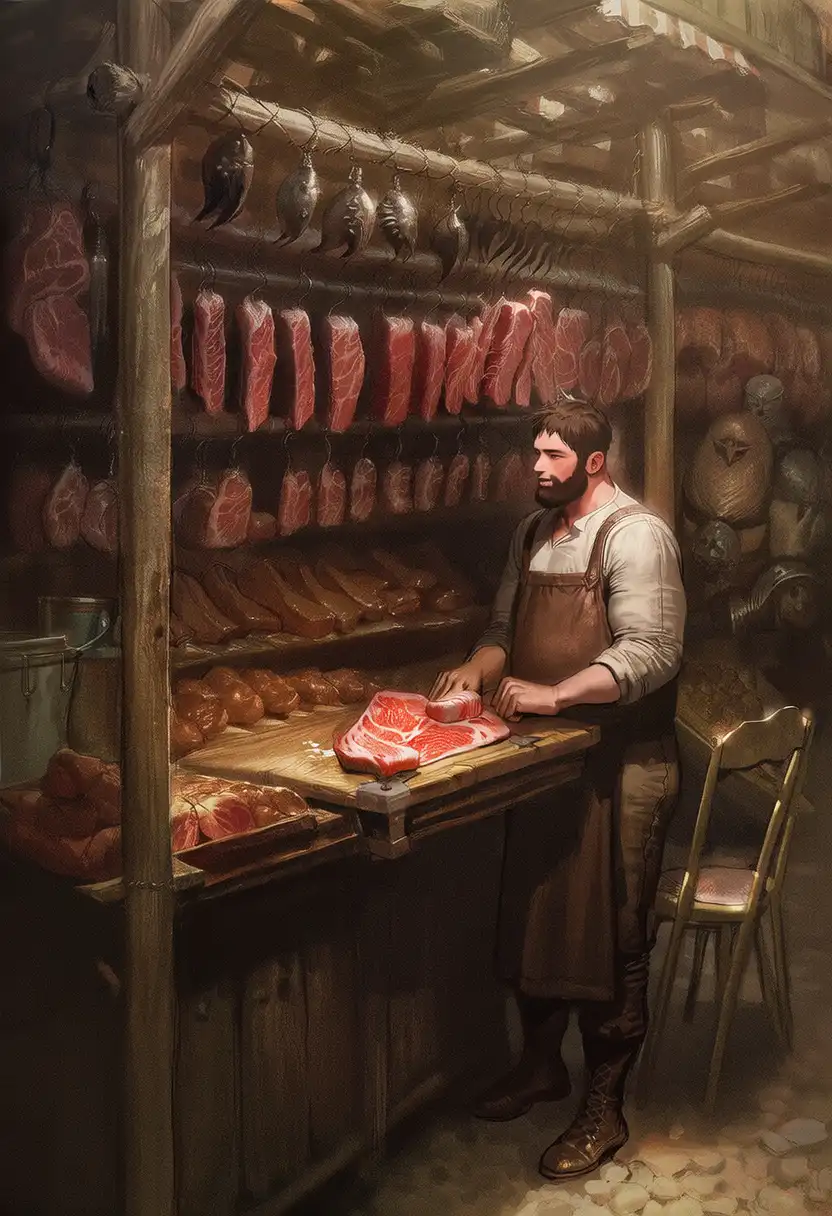
Plenty o' Meat Butchery. Come to think of it, today was my meat-buying day.
In Greenhill, when beef and pork are slaughtered, most customers buy the relatively cheap cuts—fore- and hind-leg meat, offal, and the like. The expensive cuts, the sirloin and tenderloin, get set aside and carefully stored, then sold to purchasing agents who serve the nobility or passed along to middleman wholesalers and pack peddlers. And so, despite living in the region with the most abundant meat, the common folk of Greenhill rarely get to taste a proper cut. Still—at least the soup served at the inns here has considerably more meat in it than anywhere else!
Meat? What about selling food products? Watching the line, the thought came to me all at once. Meat was relatively cheap here. Dairy like milk, eggs, and cheese contained not a single chemical additive—in Korea they'd rank as the finest organic goods money could buy. And the beef here was exceptional even among those.
Beef was expensive in Korea too. Granted, that was mostly hanwoo, premium Korean cattle. My memory of hanwoo's flavor had gone fuzzy over the years, but even top-grade hanwoo couldn't hold a candle to Greenhill beef. The cattle here were free-range raised on vast pastures, fed good grass, never stressed—and perhaps because they grew up so well, otherworld cows were enormous, with marbling spread evenly and wide through the meat. I had a steady income now, so if I put my mind to it, regularly buying up the expensive cuts was entirely feasible.
The problem was that this world had no real refrigeration, so every slaughtered animal was stored at room temperature. Everyone, nobles included, ate meat right on the edge of spoiling—sour enough to notice—without a word of complaint. In other words, every cut I bought would have to go straight into the tiny one-person fridge in my studio apartment and sit there until I could ship it.
Ahh. The more I thought about it, the clearer it became that the whole idea was doomed from the start. Selling food in the modern world meant permits from the Ministry of Food and Drug Safety, filings, inspections—a mountain of red tape. Even if some parts were negotiable, legal trouble was the very last thing I wanted to touch. Short of selling illegally, it probably wasn't happening. And honestly, even I wouldn't trust meat of unknown otherworld origin, no matter how cheap. No regrets—food products, eliminated.
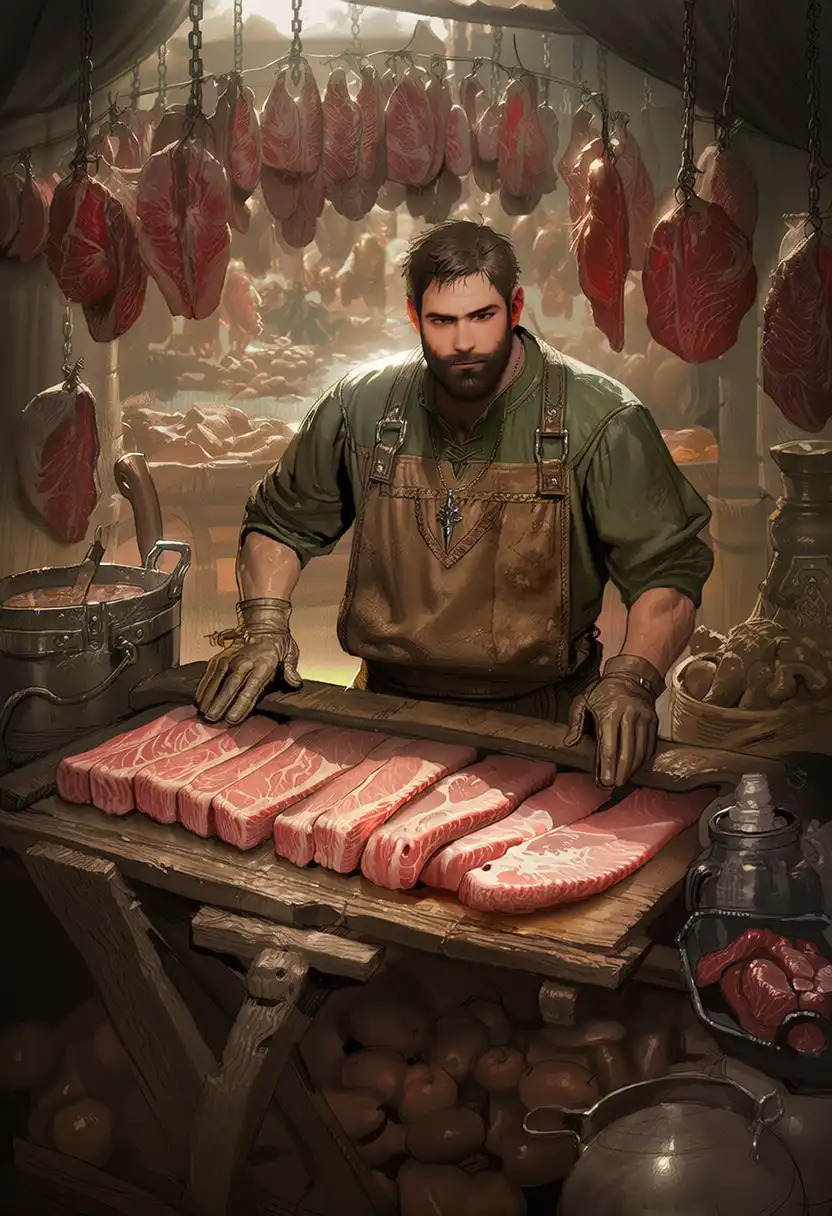
"Huh? Luciel! Luciel Gathergold! Not selling snacks today?"
I'd been standing off at a distance, staring blankly at the long line in front of the butcher shop, when the burly, stubble-jawed owner looked up from mindlessly slicing meat with an enormous kitchen knife and hailed me. I was the regular who came by once a month to buy up every premium cut he had, so of course he knew my face. My freezer's still fairly well stocked, so maybe I should skip meat purchases this week... but out of loyalty, I should probably buy a little anyway?
"It's my day off."
"Perfect timing, then. Here, try this!"
Even amid the chaos of customers, the owner of Plenty o' Meat Butchery held something out to me: a slice of beef, cut thin the very moment the cow had been slaughtered. Of course, no such thing as yukhoe—raw beef—existed as a dish here. But I had once deliberately asked him for it. Even though the fashion here was to call eating raw meat downright barbaric, the people in the meat trade knew perfectly well what flavor only beef sliced straight off a freshly felled cow could offer. So a layman who knew that taste and asked for it on purpose must have struck him as a curiosity.
Not that I'd been staring in hopes of a freebie. I'd somehow ended up cast as a stray cat begging for scraps, but I accepted the offer without hesitation and devoured it in one bite. Wow. The juices flooding my mouth like mad! The meat so tender it practically melts! This really is the best beef around! I could down a whole pound of this without even dipping it in raw egg!
"Gah. Raw meat."
"Won't he make himself sick, eating like that?"
"Like a savage."
The residents in line clicked their tongues, worrying over me. You're the ones who should be worried. Never having tasted yukhoe means you've forfeited half of what life has to offer. I quickly finished the slice and pulled copper coins from my money pouch. Meanwhile, the butcher's wife was doling out equal portions of finely chopped beef tendon into the customers' baskets.
"How much do I owe you?"
"Money, between us? You know how much my boy Henson loves your snacks."
Ah... right. To be honest, over two hundred kids come by every day clutching their grubby little copper coins. I couldn't recall his face at all, but I played along. "Next time I see your son, I'll throw in some extra snacks on the house. I'm doing business research right now."
"Business research? Planning to sell something besides snacks?"
Curious whether I might be bringing in something new, the butcher planted his knife in the cutting board and looked at me. I shook my head—too early for that—and explained that I was currently hunting for goods I could export back to my hometown.
"Oh, aye? Then ordinary goods won't cut it. Your hometown's a city of magic and alchemy, after all—the place that churns out all those fantastical sweets."
"You're too kind." It sounded wildly exaggerated, but more people treated me this way than I'd expected. Selling nothing but snacks had apparently cast me as some kind of Willy Wonka out of Charlie and the Chocolate Factory.
"Then wait just a moment! There's something I want to show you!"
As if struck by a sudden idea, the owner set down his knife and vanished into the back of the shop. His wife immediately launched into a scolding.
"Where are you going?! I could use ten hands right now!"
"Just hold on! Luciel's looking for goods from our town to sell back in his hometown!"
"Who said don't?! Do it after we're done! After!"
"Oh, would you keep it down!"
This was starting to feel awkward. I'd apparently disrupted business at the worst possible hour, through no real fault of my own. Fortunately, the owner returned quickly.
He emerged carrying a huge hunk of meat wrapped in thin cloth, both arms full. The thing was so massive that his face was hidden behind it; only the beard dangling beneath his chin was visible.
"Ours is the only shop in Greenhill that deals in this, you know."
When he peeled back the cloth, a pale crimson cut of meat was revealed. It was a color I'd never seen in pork or beef. If I had to compare it to something, it was like the cross-section of raw chicken from the supermarket... sort of. But the size was far too enormous for that comparison. The moment the unfamiliar-looking meat appeared, the eyes of everyone queued up for beef snapped toward it.
"What's this?!"
"Thigh meat from a young griffin."
"A griffin!"
"Picked it up for a fair price off an adventurer who was passing through our village last month. Lucky break."
So this was griffin meat! It was just a cut of meat, but it was my first time seeing the real thing. Griffins, I'd heard, were monsters challenging enough that only seasoned adventurers—C-Rank or higher by the standards of the big-city Adventurers' Guild—could even attempt them. The bounty for one appearing near settlements was correspondingly hefty, which was why low-ranked adventurers kept throwing themselves at griffins and dying in droves.
And obtaining a young one's meat meant the mother, who would have been near the nest, had been taken down as well. Whatever the species, a mother defending her young was at least five times harder to fight. A warrior? A mage? Or a seasoned hunter? Whoever they were, they had to be seriously skilled.
"Well? Care to have a taste?"
"...Didn't you say you got it last month?"
"Spent two days straight finishing the smoking, no rest. Griffin meat keeps well as long as you store it somewhere cool. That's why the nobles love it."
Before I could say another word, the owner had already switched to a thin blade and was shaving off a delicate slice. The tip of the meat was already passing from his hand toward my mouth.
"Here, take it."
A rare experience—there was no refusing this. I chewed the pink-tinged meat carefully, savoring it. It was definitely similar to chicken, yet carried a strangely indescribable clean, nutty richness. Wow—this is a genuine delicacy!
"Hey boss, give me some too!"
"Me too, me too!"
Sure enough, the ordinary townsfolk who'd been waiting in line swarmed the owner, desperate for a taste. Not a chance.
"No! This is a regulars-only treat. This stuff costs a fortune!"
"Tch."
"Well? Luciel. Wouldn't something like this tempt the folks back in your hometown?"
"It's certainly special."
"It's pricey, but if you're willing to do business with me, I'll let you have it in installments. What do you say?"
"Sorry, but I don't think I can sell food. People from my hometown are wary of anything they've never eaten before. It's quite far away, too."
"Is that so? Tch... What a shame, then..."
Having apparently missed his chance to offload the precious meat at a steep price to a customer with money to spend, the butcher made no effort to hide his disappointment. I explained my export-back business plan to him in a little more detail: the product had to keep indefinitely, carry some air of rarity, and be something unobtainable in my hometown.
The owner listened quietly, then stroked his beard as if something had clicked. "If that's what you're after, it's furniture, no question! Go see the Oak Drawer at the market crossroads. There'll be something your hometown folk can't resist."
Furniture?! Furniture? It had never once occurred to me to sell wooden furniture. Might be better than I expected? No telling until I look, but it's worth a visit. I thanked the butcher.
"Please wrap up one serving of the griffin meat. It's for me."
I set a pouch of fifty copper coins down on the counter, bag and all. I had no idea what it would run, but that had to be more than enough for a single serving.
"Aigoo! Thank you as always, Mr. Gathergold!"
The wife snatched up the money pouch before her husband could move. Looking sheepish, the owner scratched his head. "I'll have it wrapped up nice for you!"